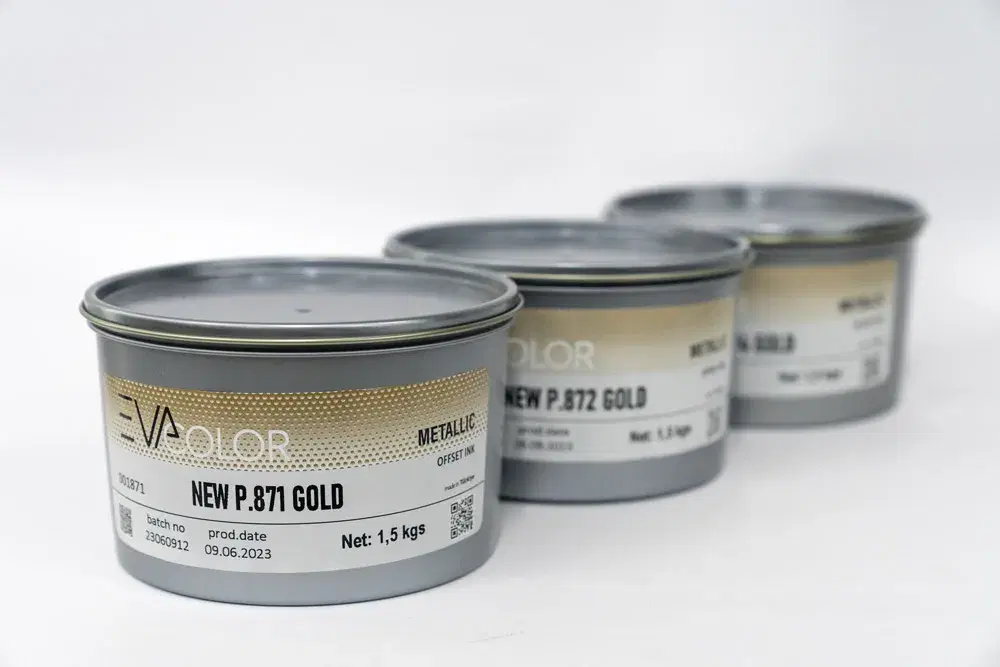
Metallic inks are the most economical way to give print a luxury, premium look: gold, silver and special metallic shades make the difference in one pass on packaging, labels, invitations and corporate print. This article explains how metallic ink shines, how SIM's own brand EVA COLOR is manufactured in Istanbul, the PANTONE equivalents of gold shades, the factors that decide brilliance on press and a comparison with hot-foil stamping, written for printers and for buyers sourcing metallic inks from Turkey. The EVA COLOR Gold and Silver product pages, our metallic printing techniques article and the printing materials guide complete this article.
01What is a metallic ink and how does it shine?
Standard inks scatter light diffusely; in metallic inks, thin platelets of bronze or aluminium alloy a few microns across (lamellar pigments) orient horizontally in the ink film and reflect light like a mirror. That specular reflection is the physical origin of the metallic sheen the eye perceives. Brilliance is judged not by the L* colour value but by gloss measured at 60° (GU); a quality metallic offset ink on gloss-coated paper reaches 85–95 GU.
The gold tone comes from the copper-to-zinc ratio of the bronze pigment: more copper (80–85%) gives a warm, reddish gold; more zinc (20–30%) a pale, cool gold. Silver inks use aluminium platelets, which are highly sensitive to iron contamination and therefore need a dedicated production and filling line. Platelet size matters too: larger platelets are brighter but coarser, smaller ones more opaque and cleaner in fine screens.
02EVA COLOR: SIM's own metallic ink brand
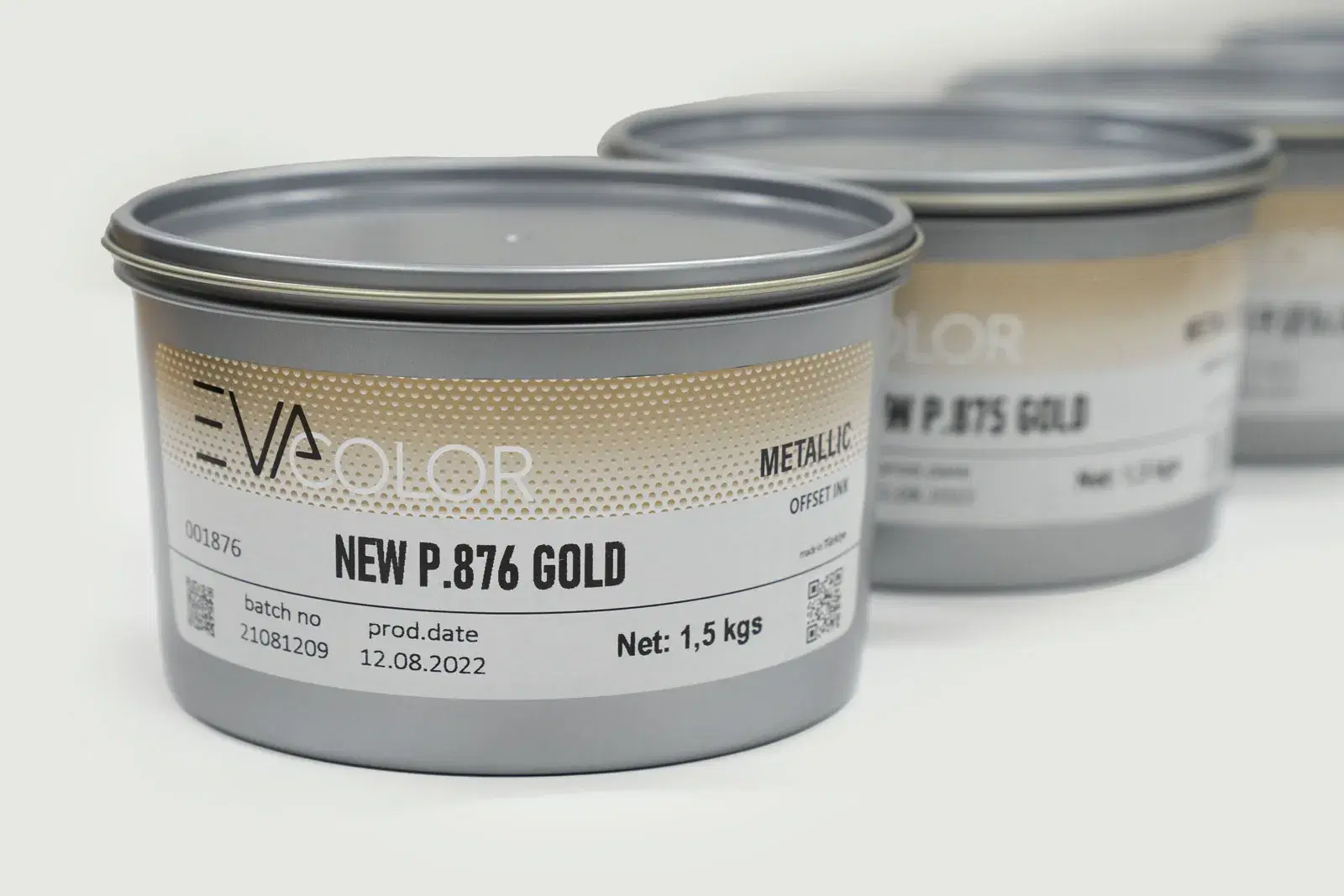
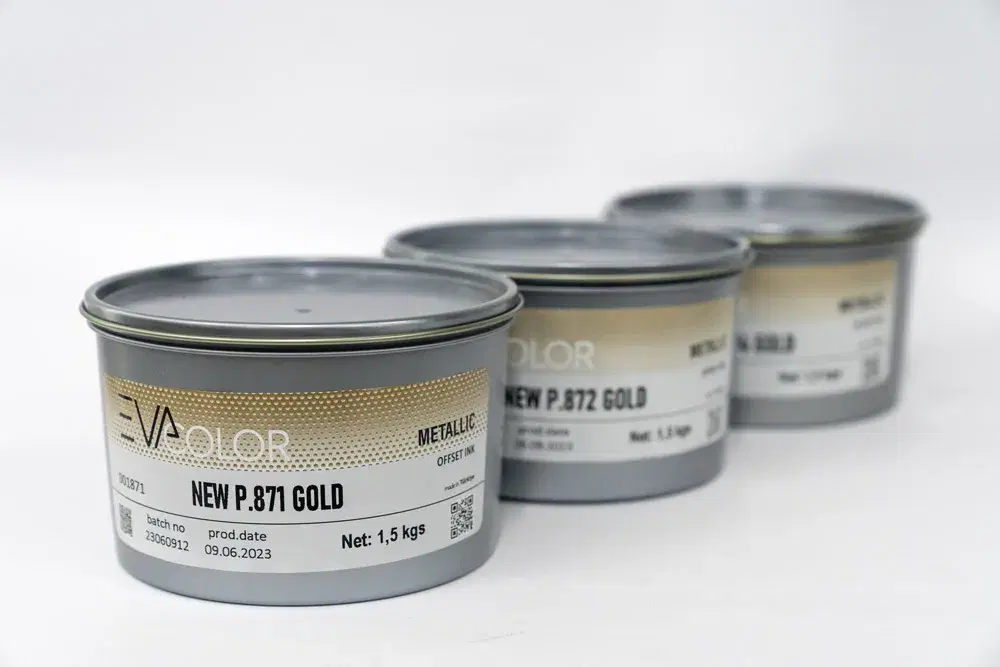
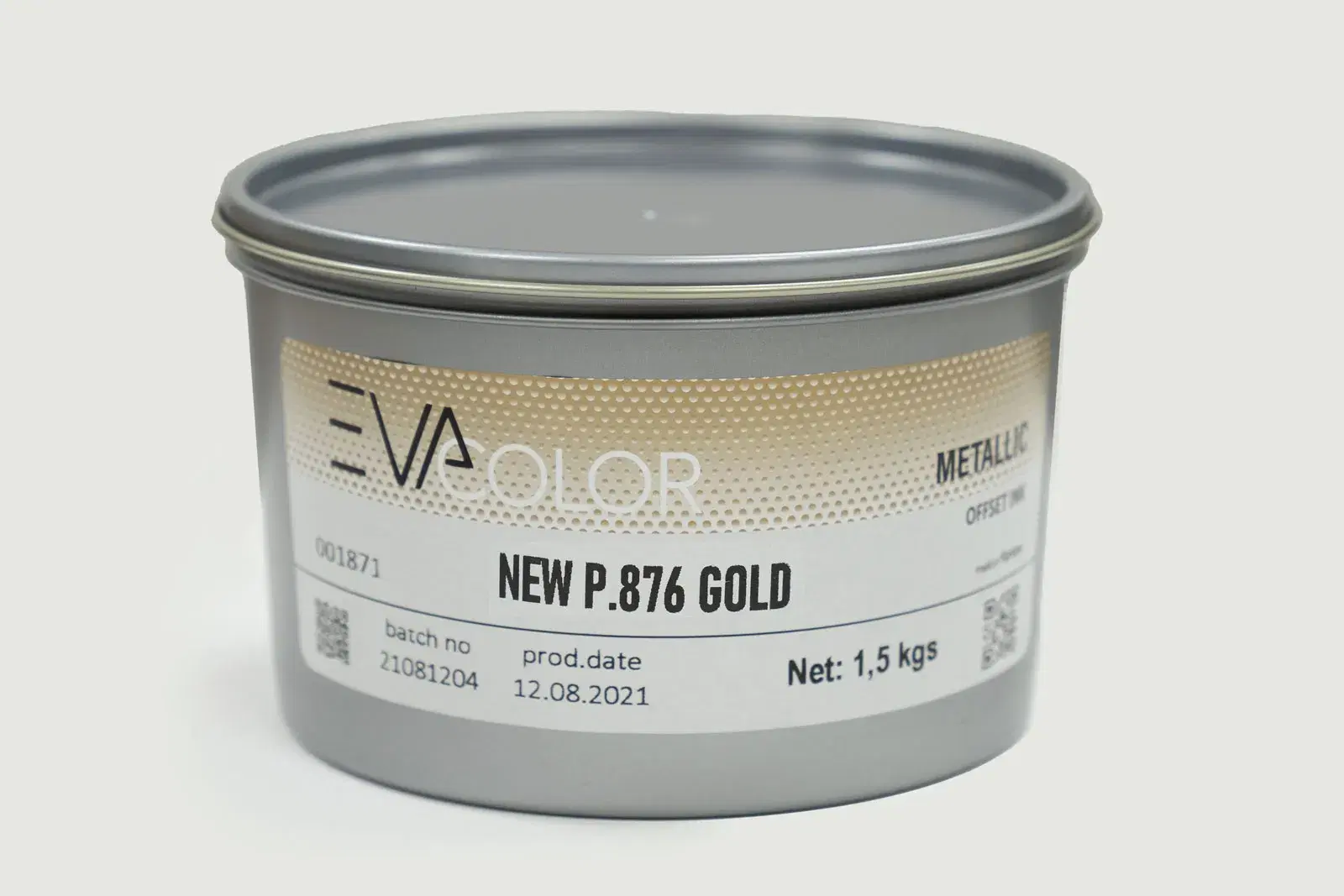
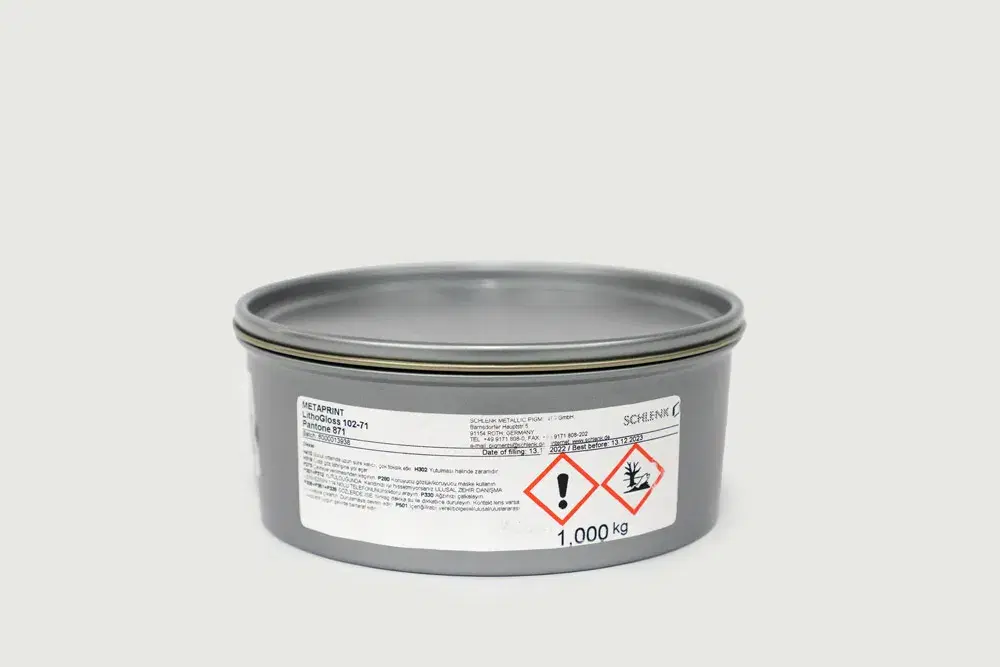
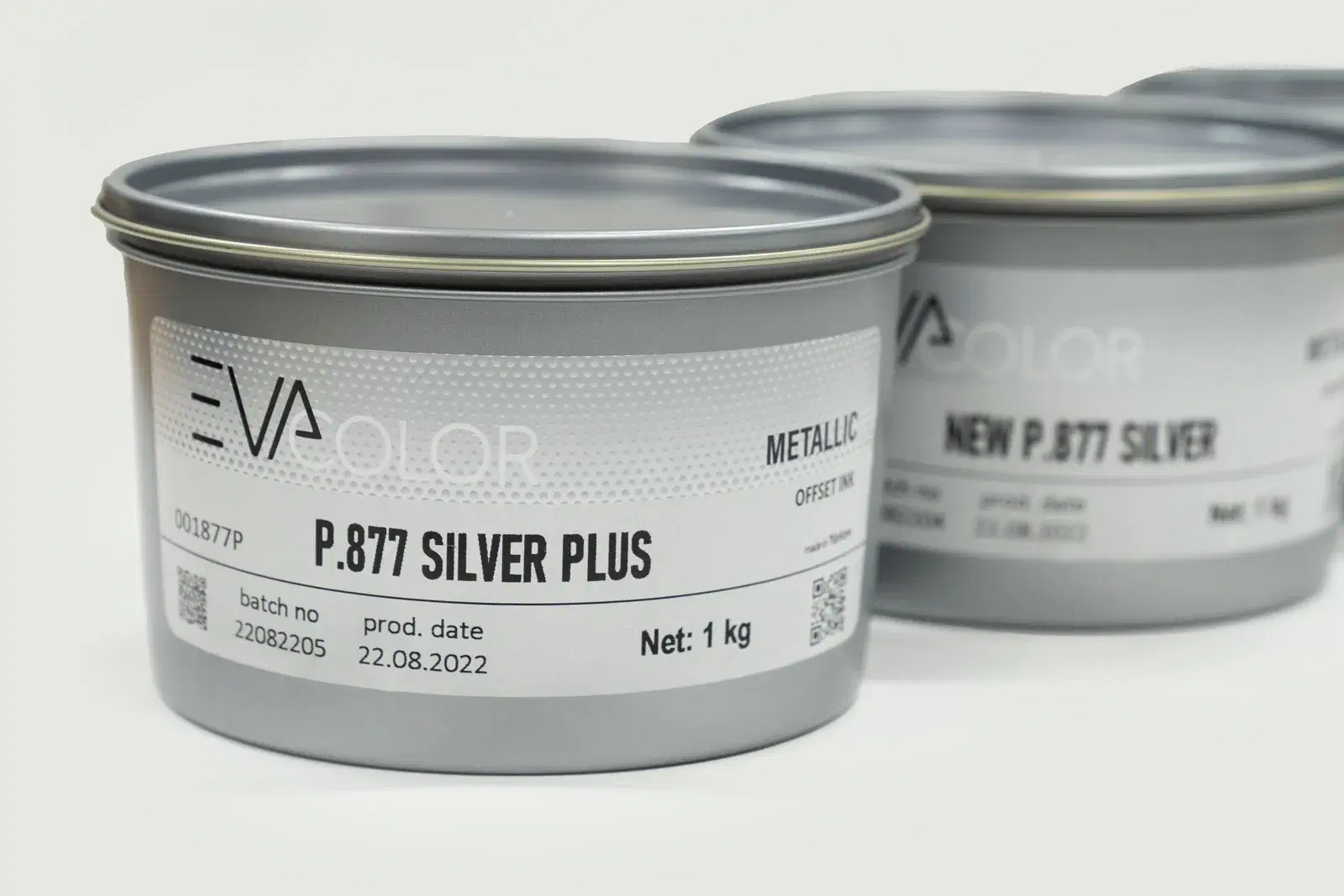
EVA COLOR is the registered brand of SIM Printing Supplies; metallic, fluorescent and custom colour offset inks are manufactured at our plant in Istanbul. The Gold and Silver series are supplied from stock in ready shades matching the PANTONE 871–877 metallic references, and job-specific gold or silver tones are formulated in our laboratory. On the pigment side we are the Turkish distributor of SCHLENK metallic pigments and inks from Germany; keeping the same pigment source on repeat orders secures lot consistency. The custom colour laboratory runs 24/7 with a monthly capacity of 15,000 kg, and export orders ship with English TDS and SDS.
03Production process: six steps from pigment to can
| Step | What is done | Control point |
|---|---|---|
| 1. Pigment selection | Bronze alloy (copper–zinc) or aluminium for the target shade; platelet size | Shade reference (PANTONE), gloss target (GU) |
| 2. Vehicle system | Varnish compatible with metallic pigment; drying type (conventional / UV) | Rheology, setting speed |
| 3. Dispersion | Low-shear mixing so platelets are distributed without breaking | Homogeneity, no loss of brilliance |
| 4. Viscosity and tack | Rheology additives for press speed and paper | Tack, flow, water balance |
| 5. Quality control | Press trial; L*a*b*, gloss and opacity measurement | Delta E against reference, GU |
| 6. Filling and labelling | Can or drum filling; batch number and production date | Traceability, shelf life |
The EVA COLOR Gold series matches the PANTONE 871–876 gold references and the Silver series PANTONE 877. Each shade offers a different warmth and brilliance; job-specific mixes are formulated in the laboratory.
04Gold shades: copper–zinc ratio and PANTONE equivalents
| PANTONE reference | Shade | Typical use |
|---|---|---|
| 871 C | Greenish, cool gold | Corporate print, certificates |
| 872 C | Pale, neutral gold | Invitations, book covers |
| 873 C | Medium warm gold | Cosmetics packaging |
| 874 C | Warm, reddish gold | Luxury packaging, beverage labels |
| 875 C | Coppery gold | Wine and spirits labels |
| 876 C | Dark copper–bronze | Premium folding cartons |
| 877 C | Silver | Technology and cosmetics packaging |
05Applications
Metallic ink is used most on luxury packaging (cosmetics, perfume, chocolate), beverage and wine labels, invitations and certificates, book and magazine covers, corporate identity print and promotional work. On medium runs it is an economical alternative to the cost of hot-foil, and it delivers full metallic solids and fine detail in a single pass. Food packaging requires a low-migration series and a compliance statement; see our packaging ink selection article for application examples.
06Printing tips: six factors that decide brilliance
First, film thickness: metallic brilliance rises with film weight, and 1.5–2 µm is optimal on gloss-coated paper; a thin film looks dull, a very thick one causes drying problems. Second, paper: gloss-coated stock gives the highest GU, while matte and absorbent surfaces lower brilliance, in which case a primer or a higher pigment load is recommended. Third, screen and coverage: metallics look best in solids and tones above 40%, light screens dilute pigment density. Fourth, print sequence: the metallic is usually printed in the first unit with transparent colours on top; printing over metallic needs an adhesion test. Fifth, drying and powder: metallic ink can set more slowly than process CMYK, so anti set-off powder is adjusted. Sixth, varnish: a dispersion varnish improves rub resistance and preserves brilliance, but some varnishes slightly yellow the metallic tone, so sample first.
07Metallic ink or hot-foil stamping?
| Criterion | Metallic ink | Hot-foil stamping |
|---|---|---|
| Brilliance | High (85–95 GU on coated), mirror effect below foil | Highest, true mirror effect |
| Cost | Ink + standard unit; no extra die | Foil + die + separate machine or unit |
| Detail and screens | Fine type and screened metallics possible | Risk of foil breaking on very fine detail |
| Run length | Economical on medium and long runs | Die cost dominates short runs |
| Finishing | Compatible with varnish and lamination (sample first) | Overprinting limited |
08Quality control: measuring brilliance, opacity and fastness
Three measurements decide a metallic ink. Brilliance is measured with a 60° gloss meter in GU and recorded together with the paper type; the same ink can lose 30–40 GU on matte-coated stock. Opacity is assessed as the contrast ratio of a film printed over a black-and-white contrast card; low opacity lets the substrate show through and dirties the shade. Fastness is measured with a rub tester (dry and wet) and for lightfastness on the Blue Wool scale; because metallic platelets can be displaced by rubbing, the decision on a protective varnish follows this test. SIM's laboratory checks every batch against the reference sample for L*a*b*, gloss and opacity and shares the measurement report with the delivery.
09Common mistakes and how to fix them
The first mistake is running a metallic ink like process CMYK, with a thin film at high speed; the result is a dull, dirty shade. The fix is a heavier film and, if needed, a lower speed. The second is expecting coated-paper brilliance on matte or absorbent stock, which calls for a primer or a higher-pigment series. The third is printing metallic on rollers still carrying conventional ink from the previous job; contamination spoils the shade and a thorough wash is essential. The fourth is handling silver ink with iron-containing spatulas and containers; the aluminium pigment reacts and brilliance is lost. The fifth is varnishing without a compatibility test; some varnishes yellow the metallic tone. Every fix starts with a press trial and a measurement.
10Storage, shelf life and safety
Metallic pigments can oxidise with air and moisture; cans must be kept tightly closed in a cool, dry place away from direct sunlight. In an opened can apply an anti-skinning spray and stir before the first use to redisperse settled pigment. Shelf life and storage conditions are stated on the TDS, transport and handling safety on the SDS; silver inks with aluminium pigment must not contact iron-containing tools. We supply these documents with the quotation in Turkish and English, with transport classification for sea and air freight.
By combining EVA COLOR metallic inks with SCHLENK pigments we deliver metallic print quality under a manufacturer's responsibility. Contact our technical team for samples, TDS and a press trial; the laboratory process is described on the custom colour production page.
Gallery
Frequently Asked Questions
- What pigments are used in metallic ink production?
- Bronze or brass-alloy aluminum pigments are used for gold tones; pure aluminum pigments for silver. SCHLENK metallic pigments with their lamellar structure provide maximum brilliance and opacity. Pigment particle size directly affects gloss and flow properties.
- Which printing systems are EVAcolor metallic inks compatible with?
- EVAcolor Gold and Silver series are compatible with conventional offset, UV offset, and hybrid UV offset systems. Special UV-cure metallic formulations are required for UV systems. SIM provides technical support for both systems.
- How does metallic ink film thickness affect brilliance?
- As metallic ink film thickness increases, opacity and brilliance rise, but excessive thickness can lead to drying problems and bleeding. A film thickness of 1.5-2 µm on glossy coated paper gives optimal results. UV varnish application significantly enhances brilliance.
- What is the difference between metallic ink and hot-foil stamping?
- Hot-foil transfers a foil under heat and pressure with a die; it gives the highest mirror brilliance but carries die, foil and separate-unit costs. Metallic ink is printed on the offset press in one pass, allows screened and fine-detail metallics and is more economical on medium and long runs; brilliance stays below foil but reaches 85–95 GU on gloss-coated paper.
Related Products
SIM Baskı Malzemeleri
Get a Custom Quote for Your Project
Contact us for information about our wide product range and custom color production.