Supplying the Turkish printing industry for 43 years

Printing Materials & Supplies: Turkey's Supplier Since 1983

Every consumable a print shop needs under one roof: offset and PANTONE inks, metallic, fluorescent and UV series, printing blankets, pressroom chemicals and dispersion varnishes. We manufacture EVA COLOR inks and VECTOR blankets in Istanbul and distribute SAKATA INX, Zeller+Gmelin, Hi-Tech Coatings and SCHLENK in Turkey, shipping from our Beylikdüzü/İstanbul warehouse across Turkey and to export markets.

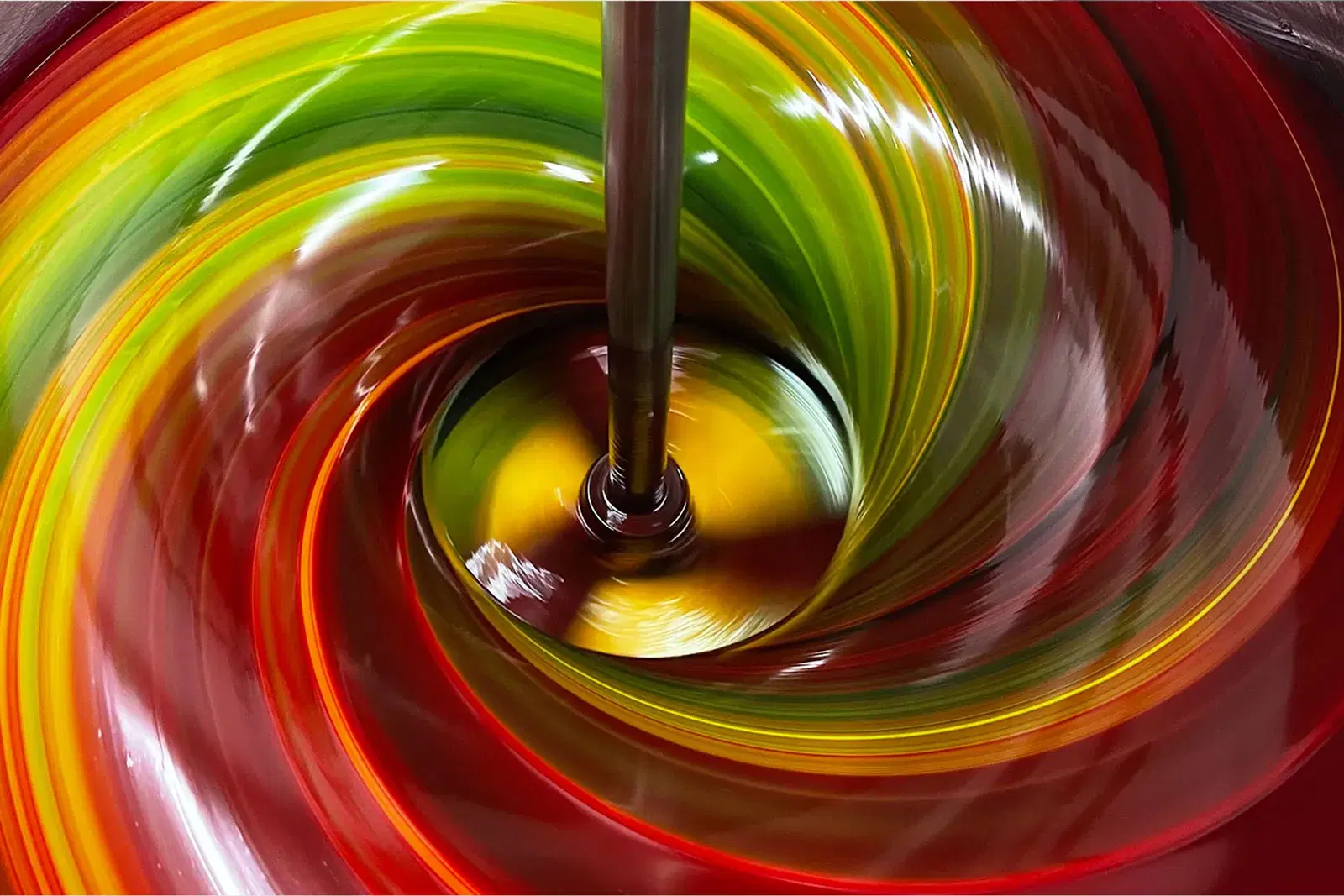
Offset ink being mixed in the SIM custom colour laboratory in Istanbul

Short answer

Printing materials are the consumables used in print production other than paper: offset, PANTONE, metallic, fluorescent and UV inks; printing blankets; fountain and wash chemicals; dispersion varnishes. SIM Printing Supplies has supplied these eight product groups from Istanbul since 1983, with stock shipped the same day in Istanbul, within 1–2 working days across Turkey, and by road, sea or air to export customers.

Key facts
Product groupsOffset (CMYK), PANTONE/custom, metallic, fluorescent and UV inks; blankets; pressroom chemicals; dispersion varnish
BrandsEVA COLOR and VECTOR (manufacturer) · SAKATA INX, Zeller+Gmelin, Hi-Tech Coatings, SCHLENK (distributor for Turkey)
ApplicationsSheetfed and web offset, UV offset, folding cartons, labels, commercial print, books and magazines
Lead timeSame day in Istanbul for stock (orders by 12:00) · 1–2 working days across Turkey · export by road, sea or air
MOQNone for stock items (single can) · 5 kg for custom colours
DocumentsTDS and SDS in English on request; ISO 2846-1 inks; low-migration options for food packaging
Laboratory24/7 custom colour lab, 15,000 kg monthly capacity, Delta E below 1.5
Founded / location1983, Beylikdüzü/İstanbul, Turkey (central warehouse and laboratory)

What are printing materials?

Printing materials are the consumable group that a print job uses up apart from paper: inks that carry colour from plate to sheet, blankets that transfer it, chemicals that keep the ink–water balance and the press clean, and varnishes that protect and finish the print. A press and a paper are chosen once; materials are consumed every shift and re-selected for every job, which makes them the real driver of print quality, waste and unit cost.

These materials are not independent. Ink tack interacts with blanket surface, driers with fountain solution pH, varnish choice with ink setting speed. A wrong decision in one item produces problems that appear somewhere else (toning, set-off, doubling, slow drying). The right approach is to select materials as a matched system and to buy them from one supplier with technical support.

This guide collects the eight product groups, selection criteria, paper–ink compatibility, the factors behind pricing and the supply process on one page. SIM has supplied these materials to the Turkish printing industry for 43 years and exports the same range with English documentation; product pages and in-depth articles are linked from each section.

The eight product groups

  1. 1Offset inks (CMYK)ISO 2846-1 process colour sets for sheetfed and web offset; the highest-volume consumable in any print shop.
  2. 2PANTONE and custom colour inksPANTONE series from stock plus custom colours formulated in our 24/7 lab to a Delta E below 1.5.
  3. 3Metallic and gold inksEVA COLOR Gold and Silver (made by SIM) and SCHLENK pigments: a metallic finish in a single pass.
  4. 4Fluorescent (neon) inksEVA COLOR Fluorescent series made by SIM, matching PANTONE 801–807 neon references.
  5. 5UV offset inksZeller+Gmelin UV and LED-UV series: cured in seconds, strong adhesion on non-absorbent substrates.
  6. 6Printing blanketsVECTOR (SIM brand) compressible blankets, cut to press size, conventional and UV-compatible grades.
  7. 7Printing chemicalsFountain additives, wash solvents, plate cleaners, driers and anti-skinning agents, anti set-off powder.
  8. 8Dispersion varnishes and coatingsHi-Tech Coatings water-based varnishes: gloss, matte, soft-touch, blister and glueable grades.

Printing materials: 8 product groups

For each group we summarise what it is, when it is used and which brands SIM holds. Product pages carry specifications, applications and FAQs.

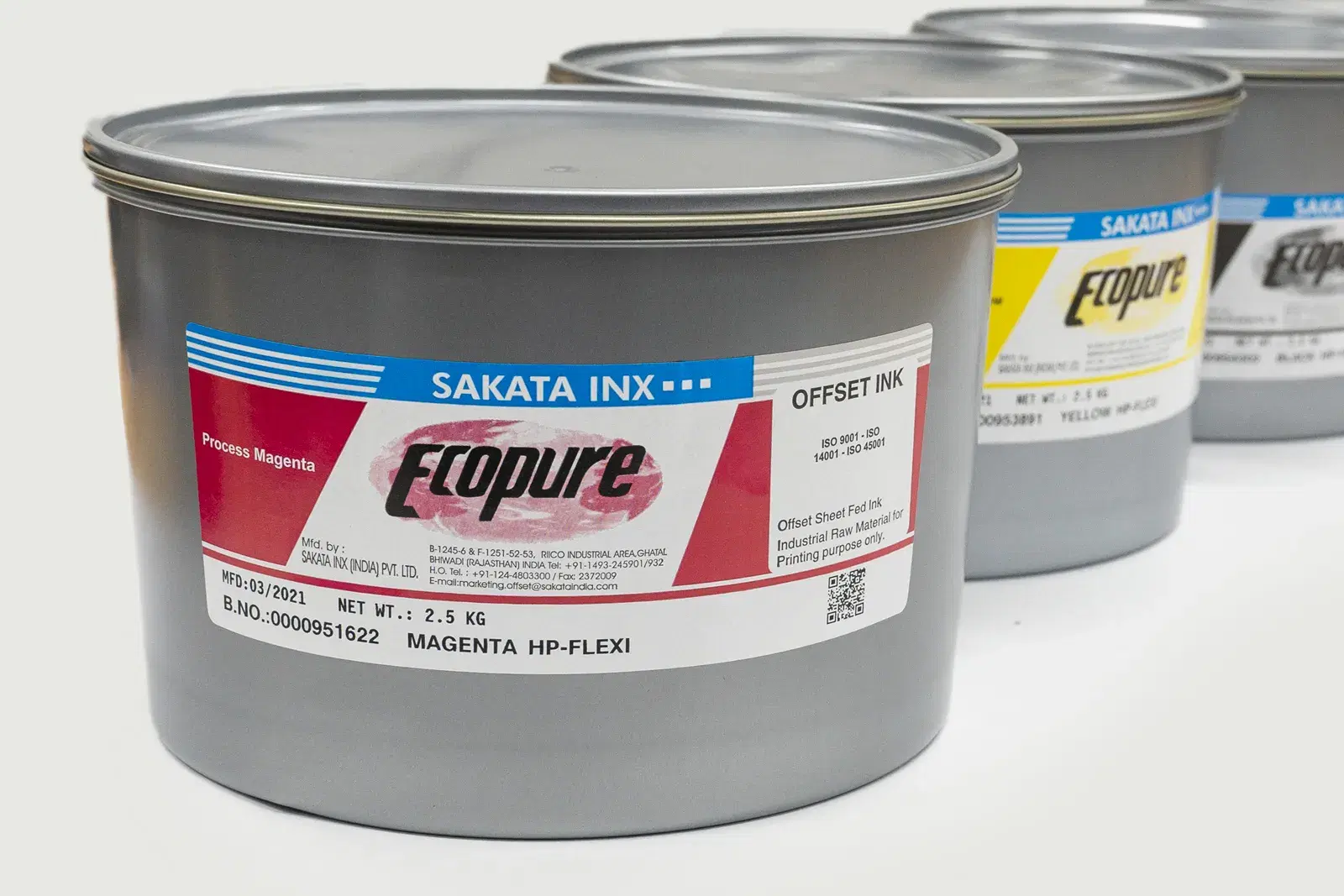
SAKATA INX Ecopure Magenta and Yellow sheetfed offset ink cans (2.5 kg)

Offset inks (CMYK)

Offset inks are paste inks (pigment, vehicle, driers) transferred from plate to blanket to paper on sheetfed and web presses. Because they are the highest-volume consumable in a print shop, colour accuracy, setting speed and press stability translate directly into productivity. Process sets (Cyan, Magenta, Yellow, Black) are formulated to ISO 2846-1 so that a FOGRA- or GRACoL-based prepress workflow reproduces on press what the operator saw on screen.

SIM is the Turkish distributor of SAKATA INX sheetfed CMYK inks (since 2002). High pigment loading reaches target density with a thinner film; balanced tack allows fast running without picking or linting. Standard sets ship from stock in our Istanbul warehouse; fast-setting and low-VOC options are selected with your press conditions in mind. Export orders are packed for sea, road or air freight with full technical documentation.

When to use: All conventional sheetfed work on coated and uncoated paper: commercial print, magazines, catalogues, brochures, books and folding cartons. For non-absorbent plastics and metallised board, see UV inks.

Brands at SIM: SAKATA INXView product
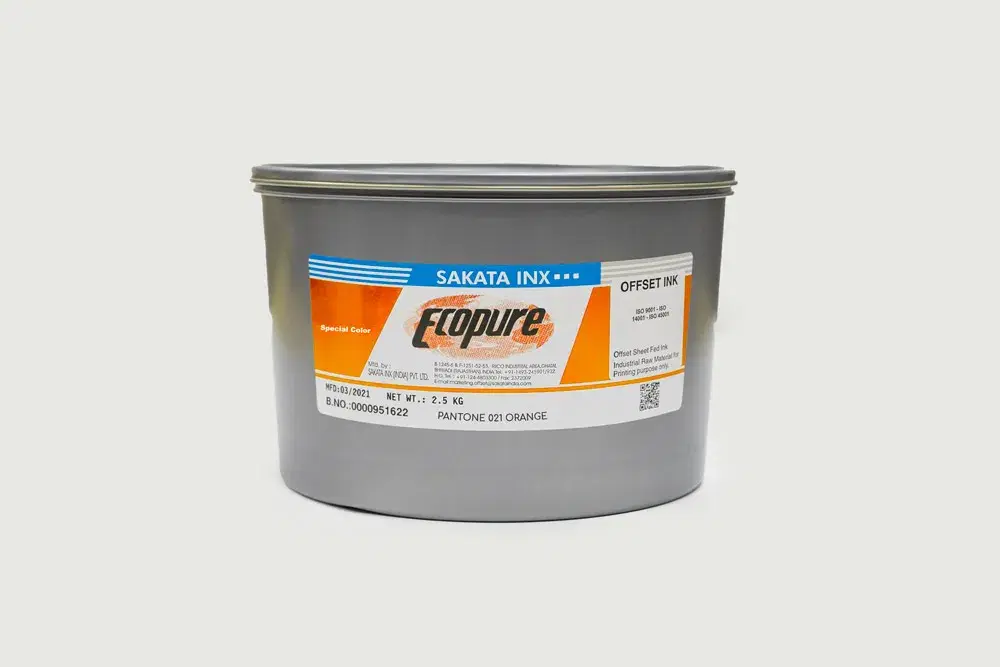
SAKATA INX Ecopure PANTONE 021 Orange spot colour offset ink

PANTONE and custom colour inks

PANTONE (PMS) inks print brand colours that four-colour screening cannot reach: solid, consistent and in one pass. Every reference in the PANTONE Formula Guide is a defined mix of base colours, and accuracy is proven with a spectrophotometer as a Delta E value. Coated and Uncoated references look different with the same ink, so the target substrate must be fixed before formulation.

SIM offers two routes: SAKATA INX PANTONE series from stock, and custom colours produced in our 24/7 laboratory in Istanbul. A PANTONE code, a printed sample or an L*a*b* reading is enough; formulations target Delta E below 1.5 and ship 1–3 working days after sample approval. Minimum custom order is 5 kg and monthly capacity of 15,000 kg keeps lot-to-lot consistency on long packaging runs. Recipes are archived, so a repeat order abroad receives exactly the same colour.

When to use: Logo and brand colours, packaging brand tones, pastels and colours outside the CMYK gamut (oranges, greens, purples), and fifth/sixth-unit printing.

Brands at SIM: SAKATA INX · EVA COLORView product
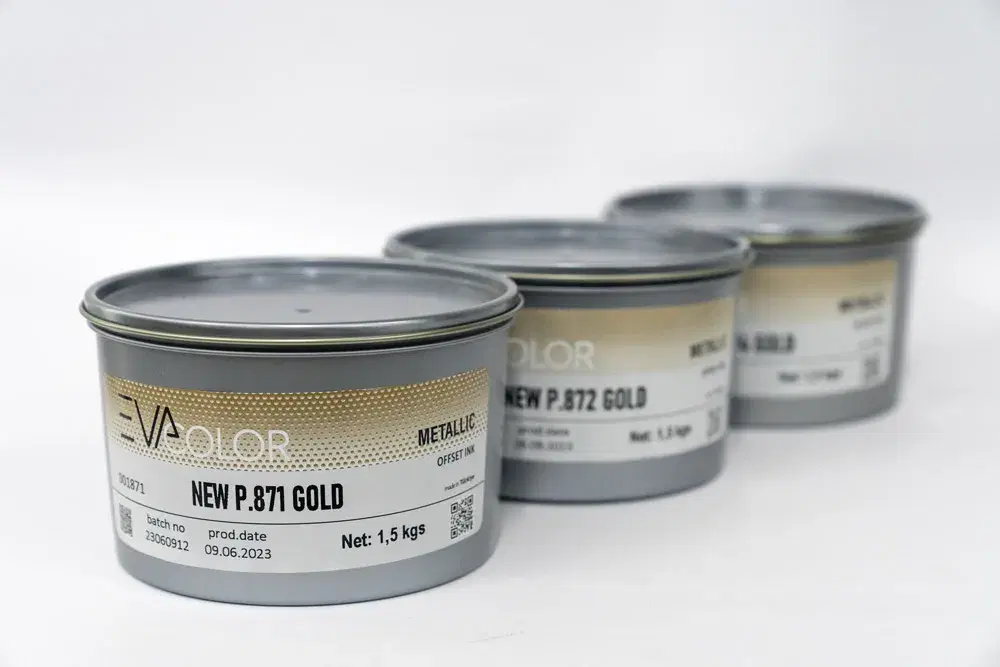
EVA COLOR NEW P.871 and P.872 Gold metallic offset ink cans (1.5 kg)

Metallic and gold inks

Metallic inks reflect light specularly because bronze (gold shades) or aluminium (silver) platelets align flat inside the ink film; brilliance is measured as 60° gloss (GU). Unlike hot-foil stamping, the effect is achieved on the offset press in one pass without an extra unit or die. The copper-to-zinc ratio of the bronze pigment sets the gold tone: more copper gives a warm, reddish gold; more zinc a pale, cool gold.

EVA COLOR Gold and EVA COLOR Silver are manufactured by SIM in Istanbul, with ready shades matching PANTONE 871–877 and job-specific mixes. On the pigment side we distribute SCHLENK metallic pigments and inks from Germany. Best results come on gloss-coated stock; on matte or absorbent surfaces a primer or a higher pigment load is recommended, and a dispersion varnish on top improves rub resistance. As a manufacturer we supply export customers with TDS, SDS and samples before the first order.

When to use: Luxury packaging, cosmetics and beverage labels, invitations, certificates, book covers and corporate print; an economical alternative to hot-foil on medium runs.

Brands at SIM: EVA COLOR · SCHLENKView product
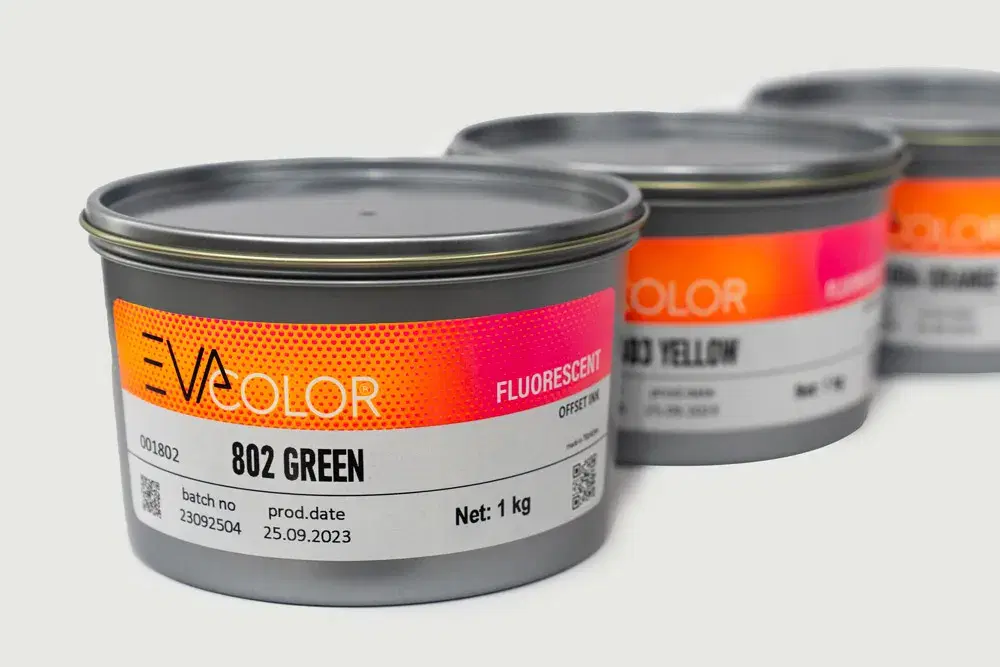
EVA COLOR 802 Green fluorescent offset ink series (1 kg cans)

Fluorescent (neon) inks

Fluorescent (neon) inks contain pigments that absorb UV and visible light and re-emit it at longer wavelengths, which is why they look far more vivid than standard colours. They are sensitive to film thickness: full coverage often needs a double hit or a heavier film, and lightfastness is lower than with conventional pigments. White gloss-coated paper and a stable, low-moisture pressroom give the brightest result.

The EVA COLOR Fluorescent series is manufactured by SIM and matches PANTONE 801–807 references; custom neon shades are formulated in our laboratory. Shelf life and storage are stated on the TDS; for outdoor use we recommend a UV-protective varnish, and for long shelf-life products a lightfastness test. Export orders are supplied with the same documentation and samples as domestic ones.

When to use: Promotional and campaign print, labels, warning and price tags that must stand out, youth-oriented packaging and event materials.

Brands at SIM: EVA COLORView product
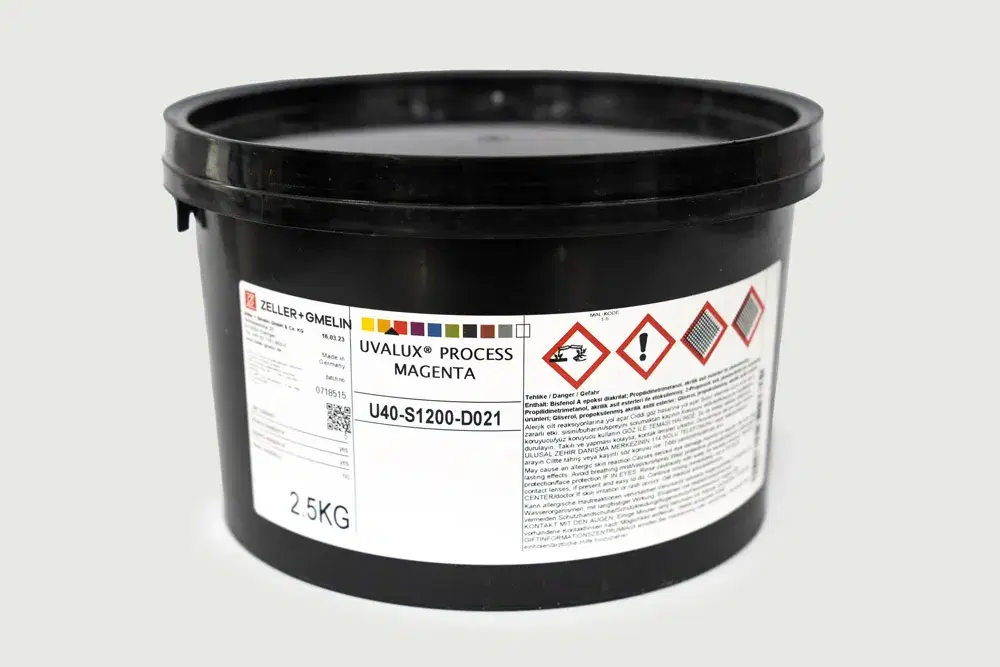
Zeller+Gmelin UVALUX Process Magenta UV offset ink (2.5 kg)

UV offset inks

UV inks cure in seconds through photoinitiated polymerisation under UV lamps, so cutting, lamination and dispatch can follow immediately. They adhere to non-absorbent substrates (PVC, PP, PET, metallised board, synthetic paper) and offer high rub resistance. LED-UV versions cure without heat and with lower energy use, which also suits heat-sensitive materials.

SIM is the Turkish distributor of Zeller+Gmelin UV offset inks from Germany. The series is chosen by curing system (conventional UV, LED-UV, H-UV) and substrate; low-migration grades are available for food packaging. When converting a press to UV, roller and blanket compatibility (EPDM) must be checked; our technicians run curing tests at the press. International buyers receive the manufacturer TDS/SDS and curing recommendations with every quotation.

When to use: Plastic and metallised packaging, labels, cards and luxury boxes; same-day jobs; any non-absorbent substrate where conventional ink would set-off or dry too slowly.

Brands at SIM: Zeller+GmelinView product
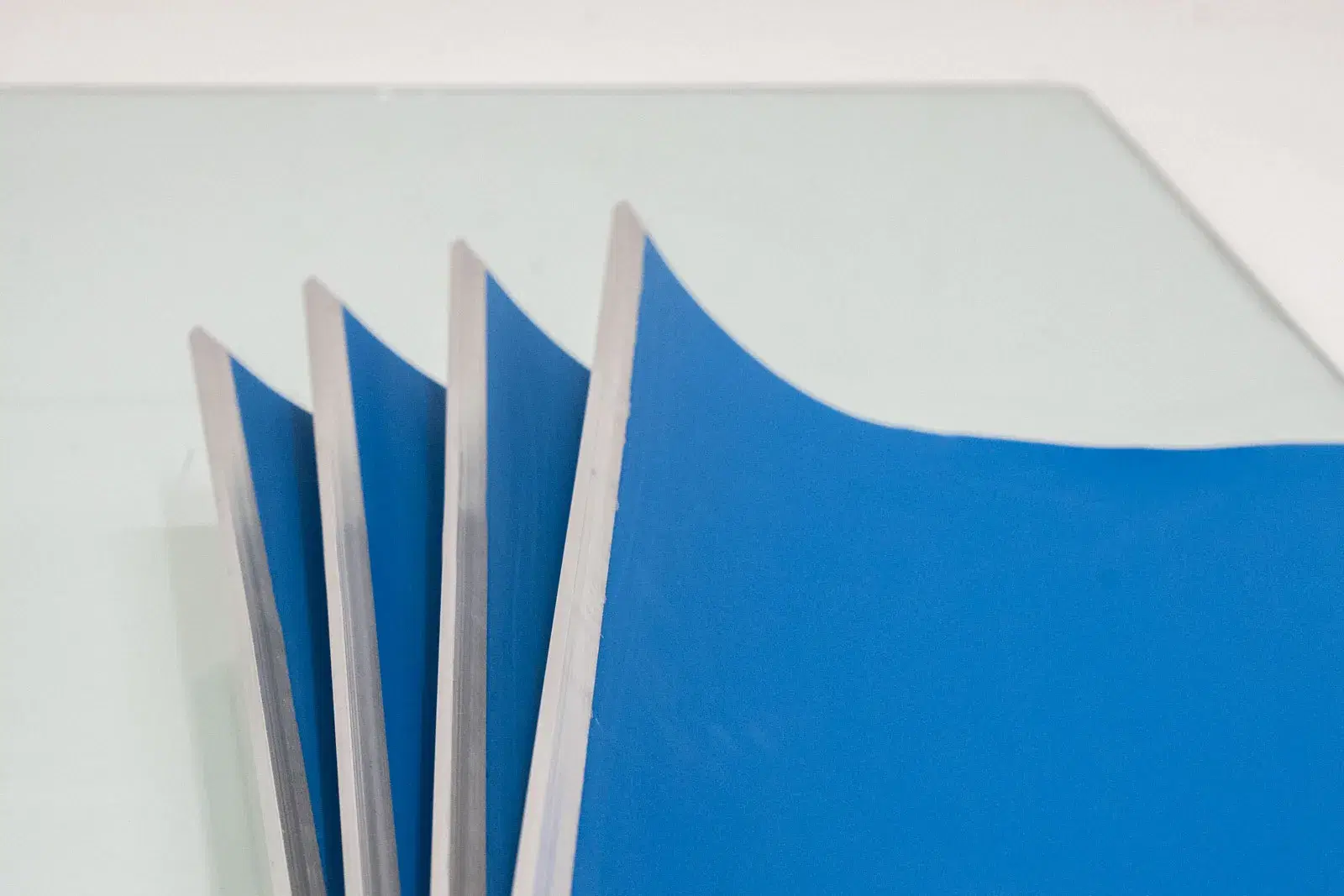
VECTOR offset printing blankets, cut and ready for the press

Printing blankets

The blanket is the rubber–fabric composite that takes ink from the plate and lays it on the paper; dot gain, dot sharpness and sheet transport depend directly on its quality. The compressible layer absorbs pressure fluctuations, while surface hardness (Shore) and roughness govern ink transfer. A worn blanket shows up as tonal drift, doubling and rising waste.

VECTOR printing blankets are SIM's own brand, cut to size for sheetfed and web presses and supplied with or without bars. Grades for conventional and UV/hybrid inks are held in stock. Depending on press conditions a blanket lasts 500,000–2,000,000 impressions; regular washing and correct tension extend its life, and calibrated packing keeps printing pressure standard. For export customers we cut to the exact press specification and ship rolled, with bar fitting on request.

When to use: Scheduled replacement on every offset press, new press installations, and conversions to UV or hybrid inks that require a compatible blanket grade.

Brands at SIM: VECTORView product
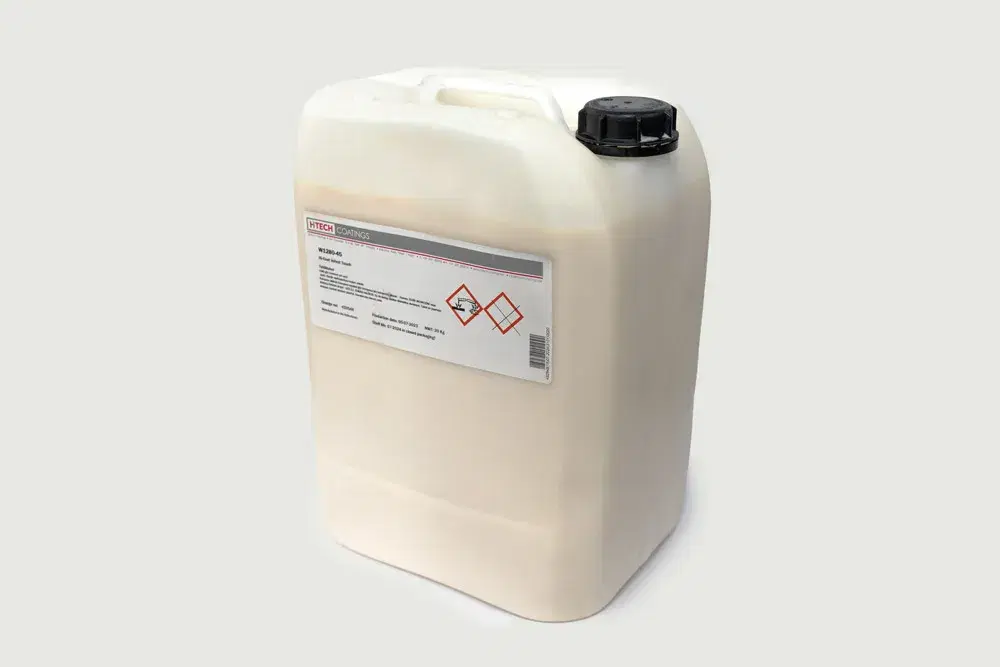
20 kg drum of printing chemical with hazard labelling

Printing chemicals

Printing chemicals are the invisible half of the offset process: fountain solution additives and IPA replacements, blanket and roller washes, plate cleaners and gums, driers and anti-skinning agents, anti set-off powder and ink additives. When the ink–water balance drifts, emulsification, toning and slow drying follow; the right chemistry directly lowers waste.

SIM supplies the complete chemical set matched to the inks and blankets it sells; the full product group and selection rules are in our printing chemicals guide and current items in the product catalogue. Every chemical ships with its SDS and a dosage table, and our technicians support IPA-free and low-VOC conversions with pH and conductivity measurements at the press. For export we provide SDS in English and transport classification for sea and air freight.

When to use: Routine consumption every shift, and the first thing to check when colour drifts, ink emulsifies, plates blind or drying slows down.

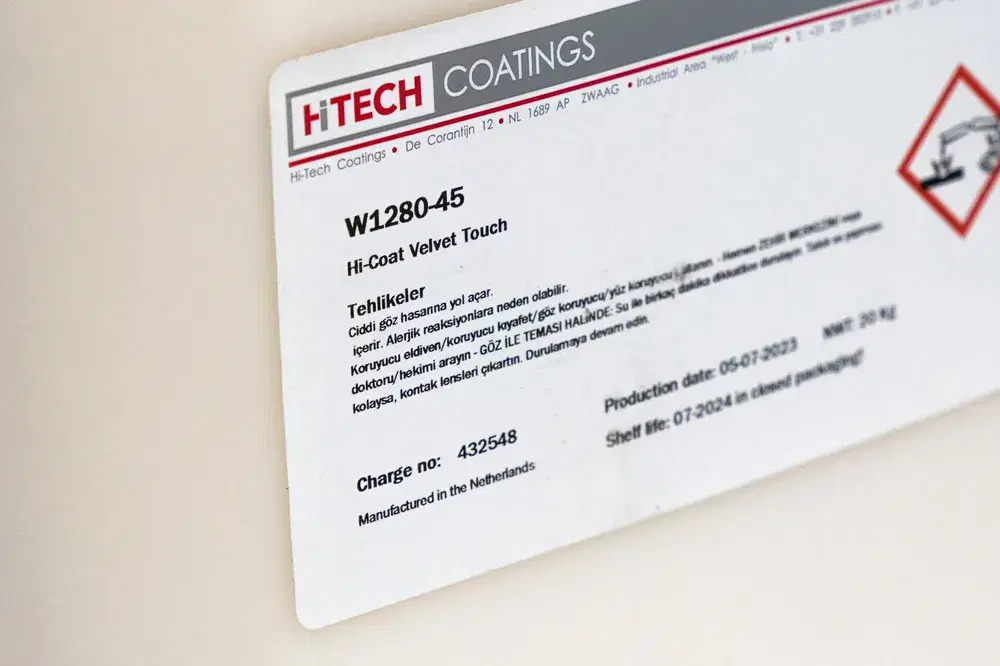
Hi-Tech Coatings Hi-Coat Velvet Touch water-based dispersion varnish label

Dispersion varnishes and coatings

A dispersion varnish is a water-based acrylic coating applied in-line from the press coater and dried by IR in seconds. It protects the print against rubbing, adds a gloss, matte or soft-touch finish and reduces cracking on carton fold lines. Compared with lamination or UV varnish it is more economical, recyclable and low-odour for food packaging.

SIM is the Turkish distributor of Hi-Tech Coatings water-based dispersion varnishes from the Netherlands: gloss, matte, soft-touch (Velvet Touch), blister and glueable grades plus protective varnishes for metallic print. Selection depends on board weight, downstream processes (die-cutting, gluing, lamination) and the target gloss level (GU). Stock is held in 20 kg drums and IBCs, and export shipments include the manufacturer's TDS and food-contact statements where applicable.

When to use: Protection and finish on folding cartons, boxes, labels, magazine covers and brochures; over metallic and fluorescent print to improve durability.

Brands at SIM: Hi-Tech CoatingsView product

Choosing the right material: 7 criteria

A purchase decision starts with press conditions, not with a price list. The seven criteria below list what to clarify before requesting a quotation and which documents to ask the supplier for.

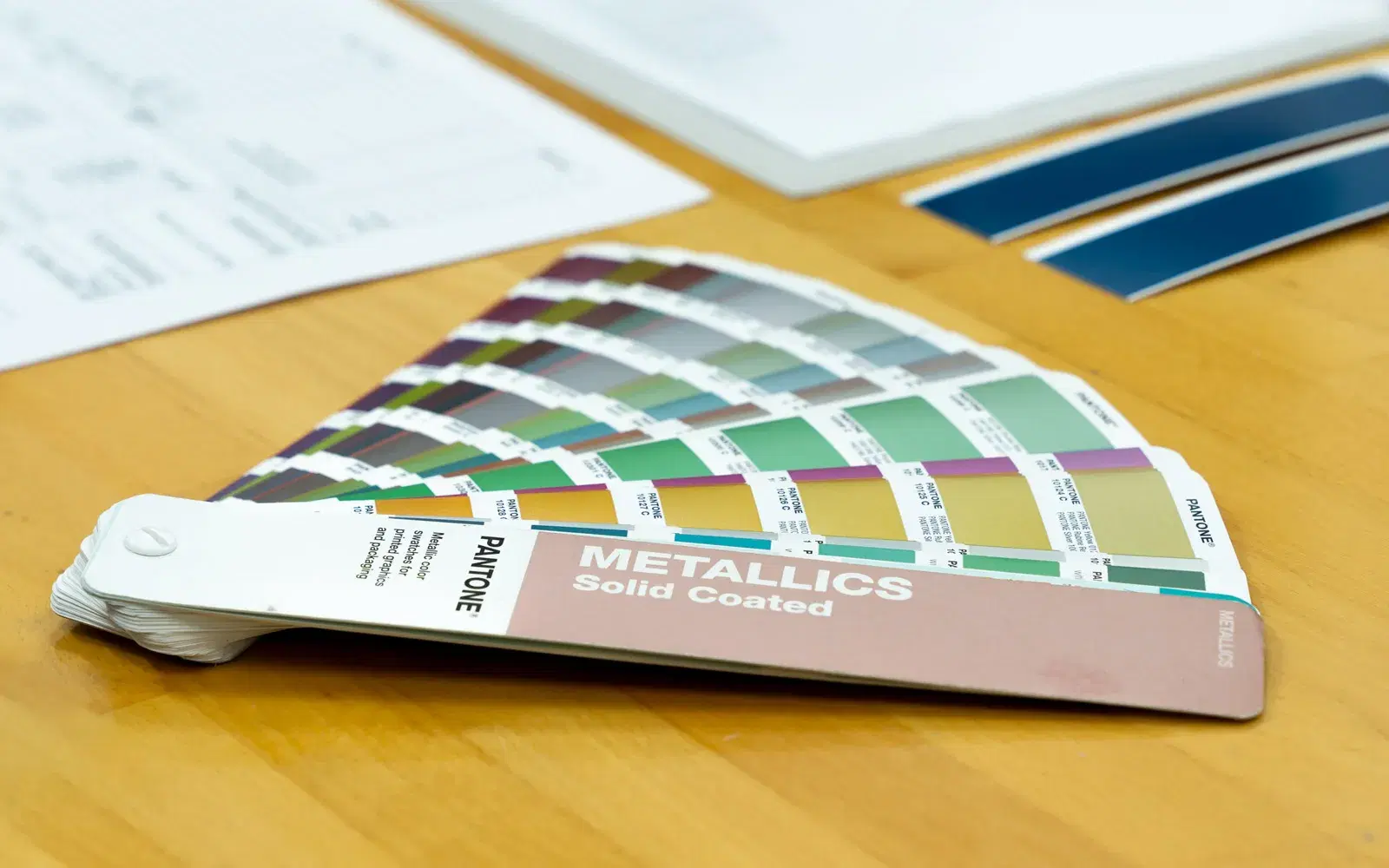
Colour selection with the PANTONE Metallics Solid Coated guide
CriterionWhy it mattersWhat to check
1. Printing process and pressSheetfed, web, UV/LED-UV or hybrid systems need different inks, blankets and chemicals.Press model, number of units, drying/curing type, roller and blanket material.
2. Paper and substrateCoated, uncoated, board, metallised or plastic surfaces change drying mechanism and adhesion.Grammage, coating, absorbency, roughness; series recommended for the substrate in the TDS.
3. Colour standardISO 2846-1 and ISO 12647-2 (FOGRA/GRACoL) compliance guarantees proof-to-press match and repeat-order consistency.Standard declaration, Delta E target, PANTONE reference and paper type (C/U).
4. Drying and finishingLamination, varnishing, die-cutting and gluing are limited by setting time and varnish compatibility.Set-off resistance, drying time, varnish/lamination compatibility, rub test.
5. Regulation and safetyFood packaging, toys and cosmetics require low migration and documentation.SDS, low-migration statement (Swiss Ordinance / Nestlé guidance), EuPIA compliance.
6. Supply continuityA stock-out on a critical item stops production; lot changes can shift colour.Stock policy, lead time, lot tracking, recipe archive.
7. Technical support and documentsProblems are solved at the press; deciding without TDS/SDS and samples is risky.On-site support, sample policy, TDS/SDS access, measurement (spectrophotometer, pH, conductivity).

Ink compatibility by paper and substrate

The same ink behaves differently on different surfaces: it dries by penetration on absorbent paper and by oxidation or UV curing on coated and plastic surfaces. The table summarises the recommended ink group and watch-points per substrate.

SubstrateRecommended inkNote
Gloss-coated paperConventional CMYK, PANTONE, metallicBrightest surface for metallic and fluorescent; powder or varnish against set-off.
Matte-coated paperConventional CMYK, PANTONERub-mark risk; protective matte varnish recommended. Metallic brilliance drops.
Uncoated (offset) paperFast-setting CMYK, Uncoated PANTONEHigh absorbency lowers density; use Uncoated references.
Kraft and recycledHigh-pigment CMYK, opaque white underprintPaper shade shifts colour; proofing is mandatory.
Folding carton boardConventional or UV CMYK + dispersion varnishFlexible varnish against cracking on folds; low migration for food contact.
Metallised board, PP, PET, PVCUV / LED-UV inkConventional ink will not dry; adhesion test and EPDM blanket.
Labels (coated label stock, PE/PP film)UV or low-migration conventionalUV varnish or lamination for rub and water resistance.

6 factors behind printing material prices

Printing material prices are not a single list figure; within one product group, raw material, brand, packaging and technical requirements create a wide range. Knowing why a quotation changes makes comparison between suppliers fair.

  1. 1

    Pigment and raw material

    Bronze/aluminium pigments in metallics, special pigments in fluorescents and photoinitiators in UV inks multiply cost against CMYK. Higher pigment loading raises the price per kilogram but lowers consumption.

  2. 2

    Brand and origin

    Distributed products from Japan, Germany and the Netherlands and SIM-made EVA COLOR and VECTOR sit at different price–performance points; both come with the same documentation.

  3. 3

    Packaging and quantity

    1 kg and 2.5 kg cans, 20 kg drums and IBCs lower the unit price. Wholesale and recurring orders qualify for annual contract pricing.

  4. 4

    Custom colour formulation

    Laboratory time, sampling and recipe development; minimum 5 kg. Repeat orders are faster and cheaper because the recipe is archived.

  5. 5

    Technical requirements

    Low migration, LED-UV, fast setting or high rub resistance add formulation work and documentation.

  6. 6

    Delivery and logistics

    Same-day delivery in Istanbul is included for stock; domestic freight and export Incoterms (EXW, FOB, CIF) define the final quotation.

Send us your press, substrate and job details; we reply with a product recommendation and a quotation within one working day.

Request a quotation

Supply process and delivery

Orders are handled from the central warehouse and laboratory in Beylikdüzü/İstanbul, Istanbul. Stock items are prepared the same day; custom colours enter the laboratory schedule. The process has six steps:

  1. 1

    Needs analysis

    Press, substrate, job type and target colour standard are recorded; compatibility with current materials is checked.

  2. 2

    Samples and documents

    For new products we share samples, TDS and SDS; a press trial is arranged where needed.

  3. 3

    Quotation and approval

    Quotation by packaging, quantity and delivery term; credit terms for established customers.

  4. 4

    Preparation

    Dispatch from stock or custom colour production in the 24/7 laboratory (1–3 working days after sample approval).

  5. 5

    Delivery

    Same day in Istanbul for stock orders placed by 12:00; 1–2 working days across Turkey; export by road, sea or air with customs documentation.

  6. 6

    On-site support and follow-up

    Press-side setting support on first use, then stock monitoring and periodic technical visits.

Export: we ship regularly to the Middle East, Central Asia and the Balkans; English TDS/SDS, certificates of origin and analysis are prepared with the quotation, and MOQ-free stock items can be consolidated into one shipment.

Our brands: manufacturer and distributor

SIM works with two own brands and four international distributorships. The matrix shows which product group is covered by which brand; official Turkish distributorship documents are available on request.

BrandCountryRoleProduct group
EVA COLORTROwn brand (manufacturer)Metallic, fluorescent and custom colour offset inks
VECTORTROwn brand (manufacturer)Offset printing blankets
SAKATA INXJPDistributor for Turkey (since 2002)CMYK and PANTONE sheetfed offset inks
Zeller+GmelinDEDistributor for TurkeyUV and LED-UV offset inks
Hi-Tech CoatingsNLDistributor for TurkeyWater-based dispersion varnishes and coatings
SCHLENKDEDistributor for TurkeyMetallic pigments and metallic inks

Why SIM since 1983?

SIM Printing Supplies was founded in Istanbul in 1983 and has served the same industry from the same address for 43 years. The facts below are not a slogan but commitments you can verify during the order process.

  • Founded

    1983 — 43 years of uninterrupted supply

  • Manufacturing

    EVA COLOR inks and VECTOR blankets: two own brands made in Istanbul

  • Distributorships

    SAKATA INX (2002), Zeller+Gmelin, Hi-Tech Coatings, SCHLENK

  • Laboratory

    24/7 custom colour laboratory, 15,000 kg monthly capacity

  • Colour assurance

    Spectrophotometric measurement, Delta E below 1.5, ISO 2846-1 inks

  • Logistics

    Central warehouse in Beylikdüzü/İstanbul; same day in Istanbul, 1–2 working days in Turkey, export worldwide

  • Languages and markets

    Turkish, English, Russian and Arabic service; exports to the Middle East, Central Asia and the Balkans

  1. 1983

    SIM Printing Supplies is founded in Istanbul to supply paper, board and printing materials.

  2. 1998

    Focus moves to offset inks, overprint varnishes, blankets and pressroom chemicals.

  3. 2002

    Turkish distributorship for SAKATA INX (Japan); CMYK and PANTONE series enter stock.

  4. Later

    EVA COLOR metallic and fluorescent ink production, the VECTOR blanket brand; Zeller+Gmelin, Hi-Tech Coatings and SCHLENK distributorships.

  5. Today

    24/7 custom colour laboratory, service in four languages, nationwide distribution and export.

Printing materials: frequently asked questions

What are printing materials?
Printing materials are the consumables used in print production apart from paper: offset (CMYK), PANTONE and custom colour, metallic, fluorescent and UV inks; printing blankets; fountain, wash and plate chemicals; dispersion varnishes and coatings. Selected as a matched system, these eight groups improve colour consistency and reduce waste.
Which basic materials does an offset press need?
At minimum: an ISO 2846-1 CMYK ink set, PANTONE or custom inks for brand colours, blankets and packing cut to the press, a fountain solution additive, blanket and roller wash, plate cleaner, anti set-off powder and, depending on the job, a dispersion varnish. SIM supplies the complete set from stock in Istanbul.
How are printing material prices determined?
Six factors: pigment and raw material (metallic, fluorescent and UV cost more), brand and origin, packaging and quantity (drums and wholesale lower the unit price), custom colour formulation, technical requirements such as low migration, and delivery terms (Istanbul, domestic freight, export Incoterms). With press, substrate and job details we quote within one working day.
Is there a minimum order quantity?
There is no MOQ on stock items: a single can of ink or a single blanket can be ordered. Custom colours produced in the laboratory have a 5 kg minimum, which balances formulation cost and lot consistency. Wholesale and recurring orders qualify for annual contract pricing, and export orders can combine several items in one shipment.
Do you export, and to which countries?
Yes. We ship regularly to the Middle East, Central Asia and the Balkans and to other markets on request, by road (TIR), sea and air freight. Quotations are given on EXW, FOB or CIF terms; we prepare English TDS/SDS, certificates of origin and analysis, and customs documentation. Within Turkey, stock orders placed by 12:00 are delivered the same day in Istanbul and within 1–2 working days elsewhere.
Which brands do you distribute in Turkey?
We are the official Turkish distributor of SAKATA INX (Japan, since 2002; CMYK and PANTONE inks), Zeller+Gmelin (Germany; UV inks), Hi-Tech Coatings (Netherlands; dispersion varnishes) and SCHLENK (Germany; metallic pigments). EVA COLOR metallic, fluorescent and custom colour inks and VECTOR blankets are our own brands, manufactured in Istanbul.
Can you match a PANTONE or brand colour, and how long does it take?
Yes. A PANTONE code, a printed sample or an L*a*b* reading is enough; our laboratory formulates the colour with a spectrophotometer to a Delta E below 1.5. Delivery is 1–3 working days after sample approval, and repeat orders are faster because the recipe is archived. The laboratory runs 24/7 with a monthly capacity of 15,000 kg.
How should inks and chemicals be stored, and what is their shelf life?
Shelf life and storage conditions are stated on each TDS; the general rule is sealed original packaging, away from direct sunlight, in a cool and dry place. For opened ink cans an anti-skinning spray or a foil under the lid prevents skin formation. For chemicals, the incompatibility and ventilation rules in the SDS apply; transport classification is provided for sea and air freight.
Can I get TDS, SDS documents and samples before ordering?
Yes. Current technical data sheets (TDS) and safety data sheets (SDS) are available in English and Turkish on request for every product. Customers who want to test a new product or verify colour accuracy before a custom production receive evaluation samples, and our technical team can accompany a press trial where needed.
What makes SIM different since 1983?
43 years in the same industry from the same address: two own brands (EVA COLOR, VECTOR), four international distributorships, a 24/7 custom colour laboratory and technical support at the press. We recommend materials as a matched system rather than item by item, and complete every delivery with documentation, samples and field support, in Turkey and for export customers.
Request a quotation for printing materials

Tell us your press, substrate and job; we reply with the right product group and a quotation within one working day, in English.