In offset printing, ink selection is one of the most critical decisions behind final print quality. The wrong ink shows up as faded colours, slow drying, set-off, toning and rising waste; the right one means reaching target density with less ink, shorter make-ready and the same colour on every repeat order. This guide brings together the seven criteria to settle before requesting a quotation, a paper–ink compatibility table and a checklist, written for printers in Turkey and for buyers sourcing offset inks from Turkey. The product behind these criteria is SAKATA INX CMYK inks; see the printing materials guide for paper–ink compatibility and the other groups, and our GRACoL/FOGRA article for standards.
01What is an offset ink and why does the choice matter so much?
An offset ink is a paste system of pigment, vehicle (varnish and resin), driers and additives. It must stay in balance with water while travelling from plate to blanket to paper, set quickly on the substrate, dry within the planned time and survive finishing (varnish, lamination, die-cutting, folding). Process sets are formulated to the ISO 2846-1 colour standard, which is why a FOGRA- or GRACoL-based prepress workflow matches proof to press.
Ink is the highest-volume consumable in a print shop and it interacts with the other materials: tack with the blanket surface, drier content with fountain solution pH, setting speed with varnishing. Ink should therefore be chosen as part of a system together with blanket and chemicals. The seven criteria below are checked in order to get the ink leg of that system right.
02Colour strength and pigment quality
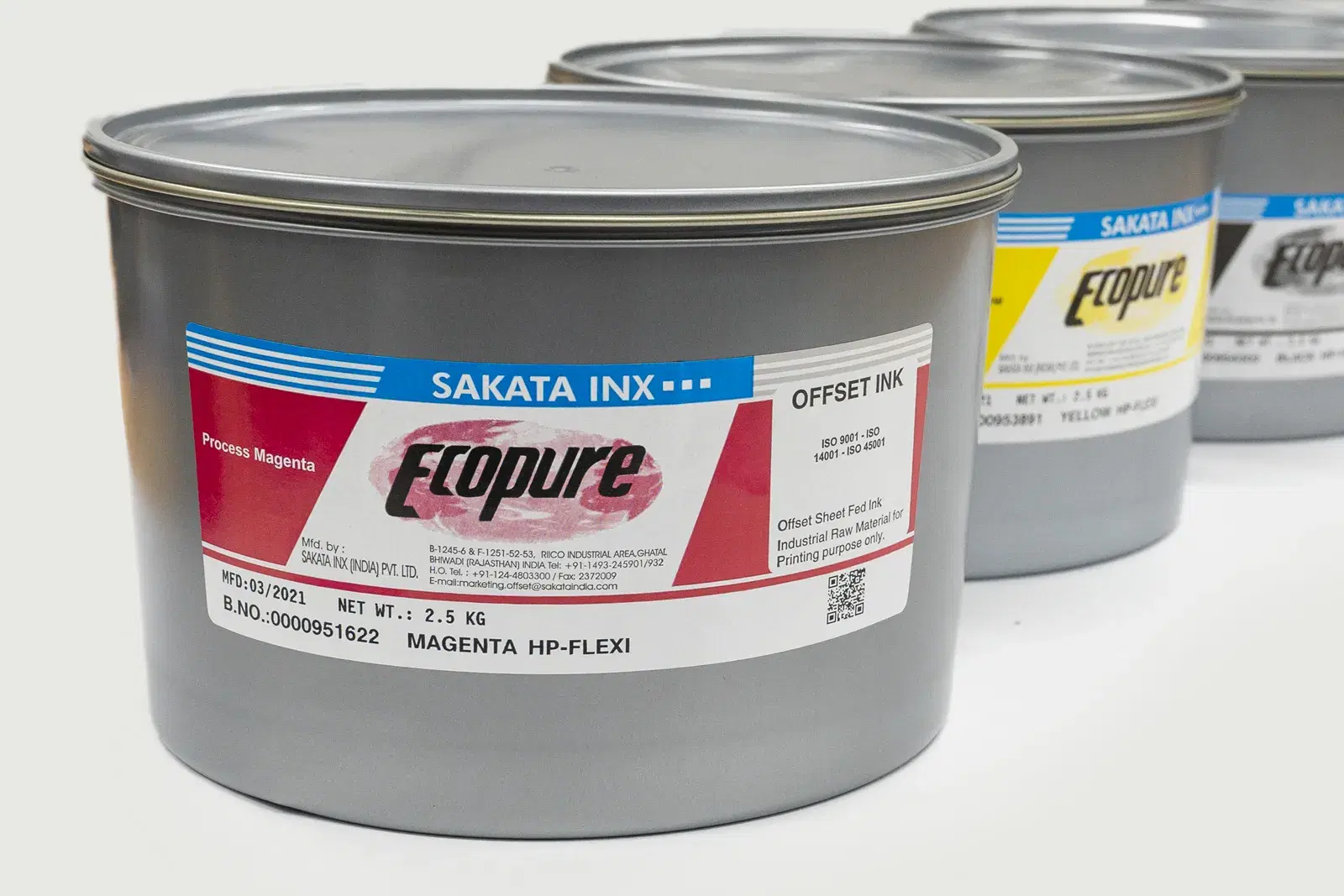
An ink with high pigment loading reaches target density with a thinner film: the same job uses fewer grams of ink, dot gain drops and drying speeds up. Pigment quality is measured by lightfastness (Blue Wool scale), transparency (clean secondaries in overprint) and shade consistency. The technical data sheet should state ISO 2846-1 compliance, the lightfastness value and the recommended density range. The SAKATA INX CMYK series documents these values on its TDS, and because the same pigment sources are used on repeat orders there is no lot-to-lot shift.
03Drying speed and mechanism
Conventional sheetfed inks first set by absorption (the solvent fraction moves into the paper) and then dry by oxidative polymerisation; the duration of both phases depends on paper, driers and pressroom conditions. A fast-setting ink lowers set-off risk in the pile, but setting too fast can cause skinning on the rollers. UV inks cure in seconds under the curing unit and are the only option on non-absorbent substrates. The question to ask: how many hours after printing does the job go to backing-up, varnishing or cutting? Causes and fixes for drying problems are in our ink drying problems article.
04Paper and substrate compatibility
The same ink behaves differently on different surfaces. Gloss-coated paper holds the ink on the surface (high density, glossy result, set-off risk); uncoated paper absorbs it (lower density, matte look, fast setting); board and metallised surfaces demand adhesion and flexibility. The table summarises the recommended ink group for the most common substrates; the full table is in the printing materials guide.
| Substrate | Recommended ink | Watch-point |
|---|---|---|
| Gloss-coated | Standard or fast-setting CMYK, PANTONE, metallic | Powder or dispersion varnish against set-off; density control |
| Matte-coated | Standard CMYK, PANTONE | Rub-mark risk; matte protective varnish |
| Uncoated (offset) paper | Fast-setting, high-pigment CMYK; Uncoated PANTONE | Absorbency lowers density; proof for shade shift |
| Folding carton board | Conventional or UV CMYK + varnish | Cracking on folds; low migration for food contact |
| Metallised board, plastics | UV / LED-UV | Conventional ink will not dry; adhesion test, EPDM blanket |
05Rub, scratch and finishing resistance
On packaging, covers and labels the ink film is exposed to rubbing during transport, stacking and use. Rub resistance is measured in the laboratory with a rub tester; a value missing from the TDS should be tested before the job. If resistance is insufficient the usual answer is a dispersion varnish or lamination, but on varnished jobs the ink's compatibility with the varnish (adhesion, gloss, yellowing) must be checked as well. Cutting, folding and gluing steps also define the window in which the ink must be fully dry.
The right ink can cut printing cost by 15–20%: a high-strength ink is consumed less, make-ready is shorter and waste lower. Compare ink and waste cost per thousand sheets, not the price per kilogram.
06Environmental and regulatory compliance
Vegetable-oil based and low-VOC formulations have become the standard for both the working environment and customer audits. Food, toy and cosmetics packaging requires low-migration ink and an EuPIA compliance statement; the Swiss Ordinance and the Nestlé guidance are the most cited frameworks. Request the SDS, the EuPIA statement and, where needed, a migration compliance certificate from the supplier. The full range of environmental options is covered in our sustainable printing article.
07Press and system compatibility
Tack and viscosity must suit the press speed, the number of rollers and the dampening system: on high-speed presses a lower tack prevents picking; with alcohol-free dampening a series with high emulsion tolerance is chosen. Blanket and roller materials matter too: UV ink requires an EPDM blanket and UV-compatible rollers and cannot be mixed with conventional ink. On perfecting presses set-off resistance, and on web presses heatset drying, are assessed separately.
08Total cost and supply continuity
The cheapest ink is rarely the most economical. Total cost is the sum of price per kilogram, consumption per thousand sheets, make-ready time, waste rate and wash chemical use. Add supply continuity: a critical item out of stock stops production, and a lot change shifts colour. The supplier's stock policy, lead time (same day in Istanbul, 1–2 working days across Turkey, export by road, sea or air), lot tracking and press-side technical support matter as much as the price.
09Selection checklist: before you request a quotation
| Criterion | Question to settle | Document to request |
|---|---|---|
| Pigment and colour | Which standard (ISO 2846-1, FOGRA/GRACoL target)? | TDS, lightfastness, density range |
| Drying | Hours until backing-up, varnishing and cutting? | Setting and drying time statement |
| Substrate | Paper type, grammage, coating; any metallised or plastic? | Series recommended for the substrate |
| Finishing | Varnish, lamination, folding, gluing? | Rub and varnish compatibility test |
| Regulation | Food contact, low migration, VOC limits? | SDS, EuPIA statement, migration certificate |
| Press | Speed, dampening type (IPA-free?), blanket and rollers? | Tack and viscosity values |
| Supply | Stock, lead time, lot tracking, field support? | Stock policy, samples, Incoterms for export |
10Common selection mistakes and what they cost
The most common mistake is choosing ink by price per kilogram alone: a low-pigment ink needs a thicker film, drying takes longer, powder consumption and set-off rise, and the saving goes to waste. The second is keeping the same ink when the paper changes; a job moving from coated to uncoated stock loses density and the operator adds ink, producing dot gain. The third is mixing UV and conventional systems on the same rollers and blanket, which guarantees swelling, hardening and loss of adhesion. The fourth is trusting a "low migration" claim on food packaging without documents. The fifth is switching to a new series without samples and a press trial. Each of these costs far more than the material itself; the checklist exists precisely to prevent them.
11How to verify ink quality on press
Three measurements are enough: solid density and 50% dot gain with a densitometer (compared with ISO 12647-2 targets), rub resistance after drying with a rub tester, and proof-to-print Delta E with a spectrophotometer. Run the trial on the same paper, at the same speed and with the same dampening settings, and record the results with date, lot and settings. That record is the only objective reference when changing supplier or comparing lots.
12Offset ink options at SIM
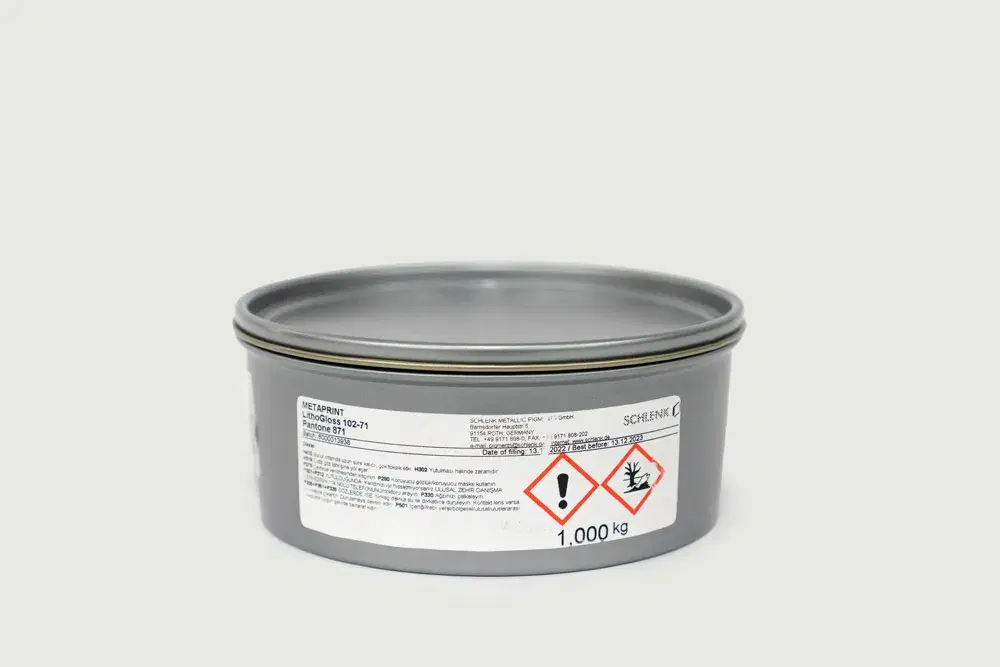
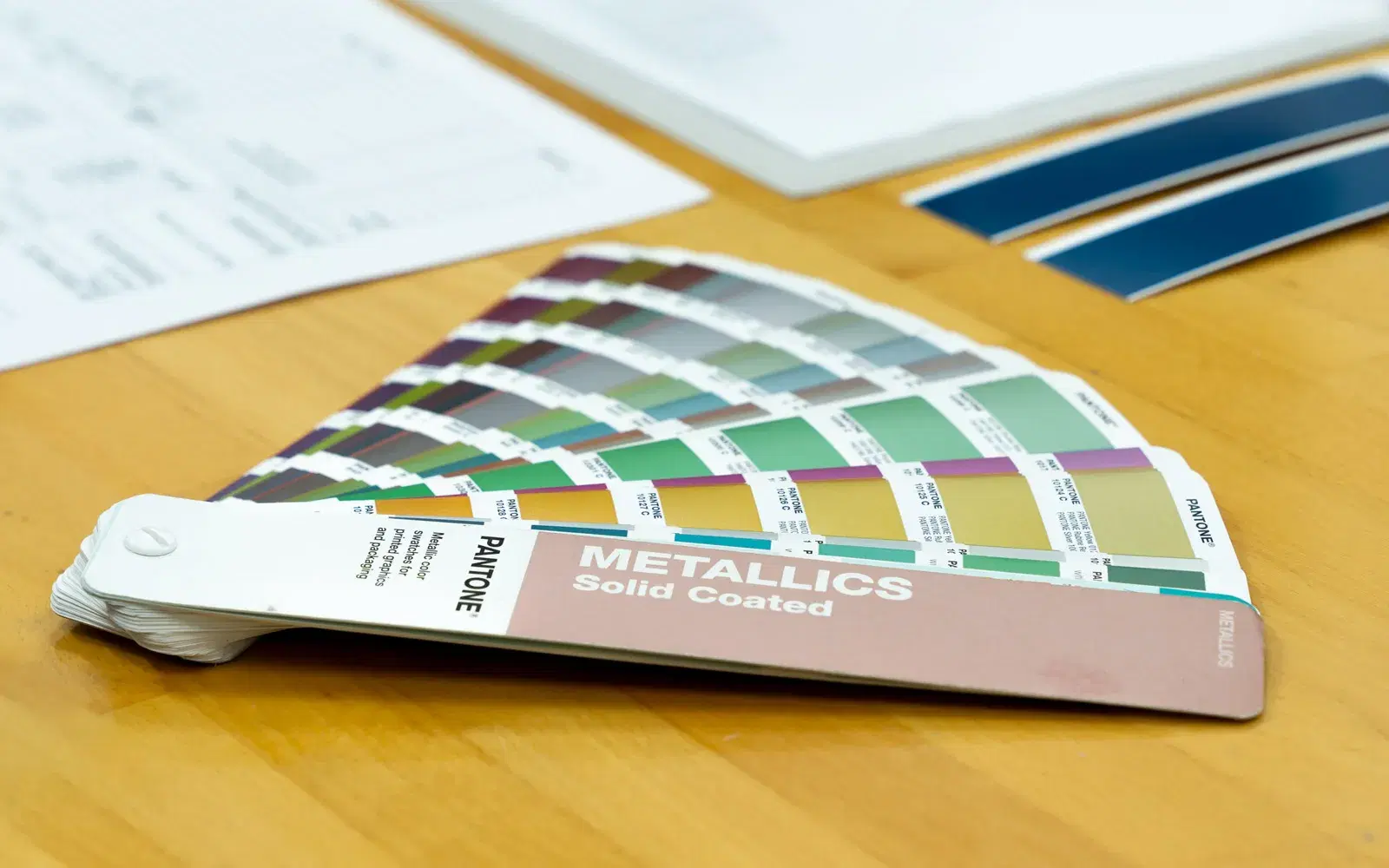
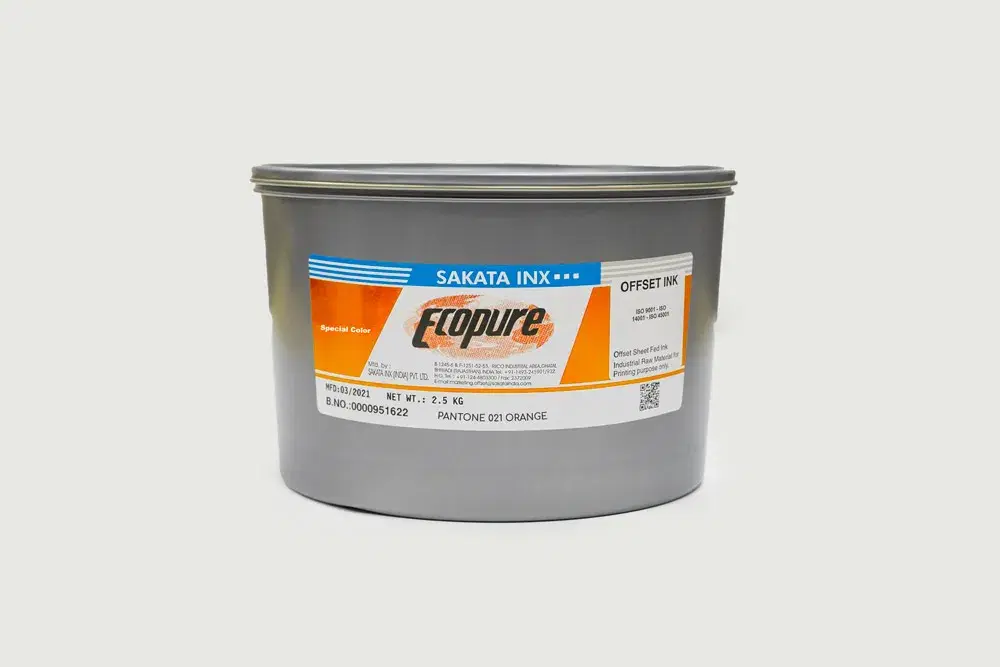
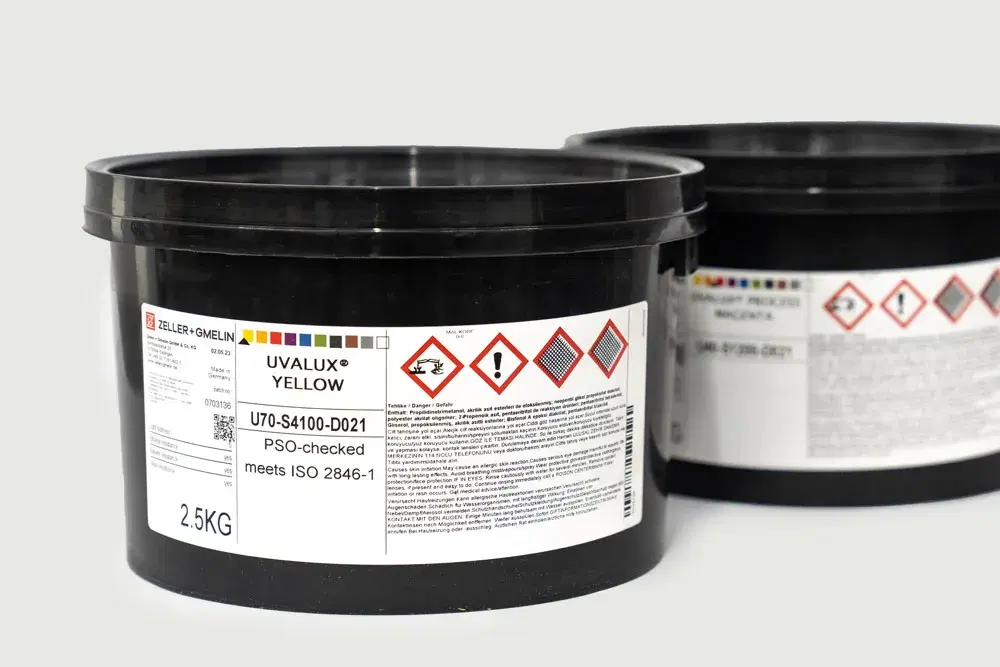
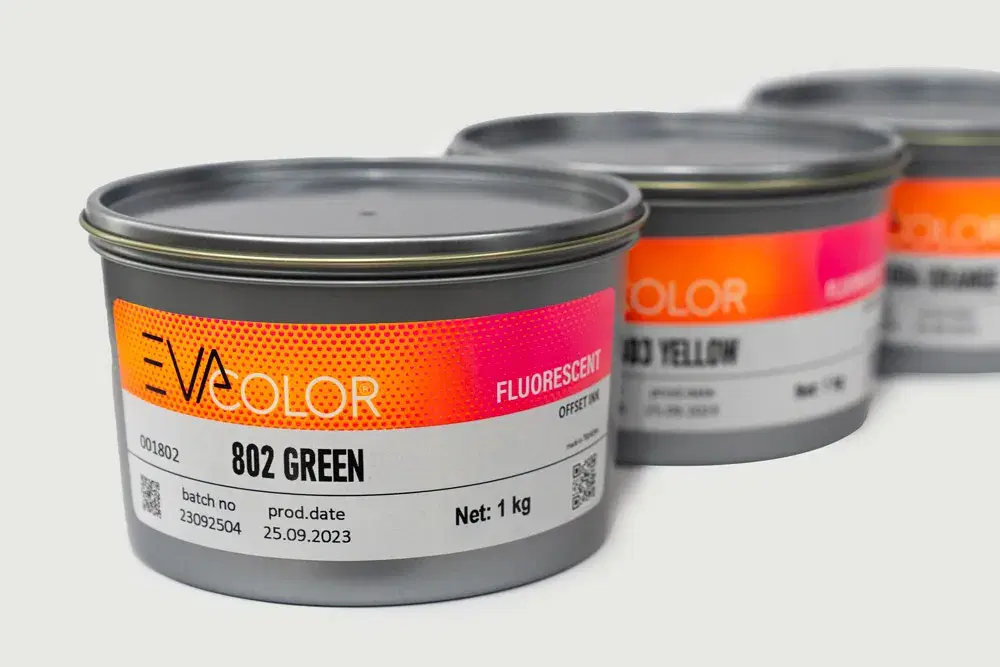
SIM Printing Supplies has supplied the printing industry since 1983 and has been the Turkish distributor of Japanese SAKATA INX sheetfed offset inks since 2002. Standard CMYK sets and the PANTONE series ship from stock in our Istanbul warehouse; EVA COLOR metallic and fluorescent inks are our own manufacture; for UV work the Zeller+Gmelin series is in stock. Custom colours are formulated in our 24/7 laboratory with spectrophotometric measurement to a Delta E below 1.5 and delivered 1–3 working days after sample approval. Export customers receive English TDS/SDS and quotations on EXW, FOB or CIF terms.
Share your press, paper and job; our technical team will recommend the right series and run a trial with samples and TDS. Ink selection is complete only when it is confirmed at the press, on the printed result.
Gallery
Frequently Asked Questions
- What is the most important criterion in offset ink selection?
- The most important criterion is paper-ink compatibility. The paper's absorbency, surface tension, and coating type directly determine ink selection. Additionally, printing speed, drying method, and end-use conditions (varnish, lamination, etc.) must be considered.
- What is the difference between cheap ink and premium ink?
- Cheap ink appears low-cost initially but increases total cost through higher ink consumption, frequent machine cleaning, increased waste rates, and lower print quality. Premium ink offers higher color strength and consistency, providing real long-term cost advantage.
- How does ink viscosity affect print quality?
- If viscosity is too high, ink transfer becomes difficult, dot gain increases, and mottle may appear. If too low, ink spreads, edge sharpness decreases, and set-off risk rises. The optimal viscosity range must be adjusted for each ink based on printing speed and paper type.
- What is the shelf life of offset ink and how should it be stored?
- Shelf life varies by product and is stated on the TDS; the general rule is sealed original packaging, away from direct sunlight, in a cool and dry place. In an opened can, an anti-skinning spray or a foil under the lid prevents skin formation; clean and close the rim after every use.
Related Products
SIM Baskı Malzemeleri
Get a Custom Quote for Your Project
Contact us for information about our wide product range and custom color production.