Colour consistency is the foundation of brand trust: the corporate colour on a package must look the same on every run, at every printer and on every paper. Custom colour matching is the laboratory process that bases that consistency on measurement rather than on the eye. This article explains why colour matching is hard, how CIE L*a*b* and Delta E turn colour into numbers, SIM's six-step laboratory process, the types of reference, the effect of paper and printing system, and the recipe system that guarantees the same colour on repeat orders, including for customers who source custom inks from Turkey. The custom colour production product page, our Pantone guide and the printing materials guide complement this article.
01Why is colour matching hard? Metamerism, surface and light
Colour is not a property of an object but the result of light, surface and eye together. The same ink looks different on gloss-coated and on uncoated paper; two colours that match in daylight can separate under shop lighting (metamerism); two "identical" colours made with different pigments behave differently under different light because their spectral curves differ. Professional matching is therefore done not by eye but by spectrophotometric measurement under a standard illuminant (D50) and on the target paper.
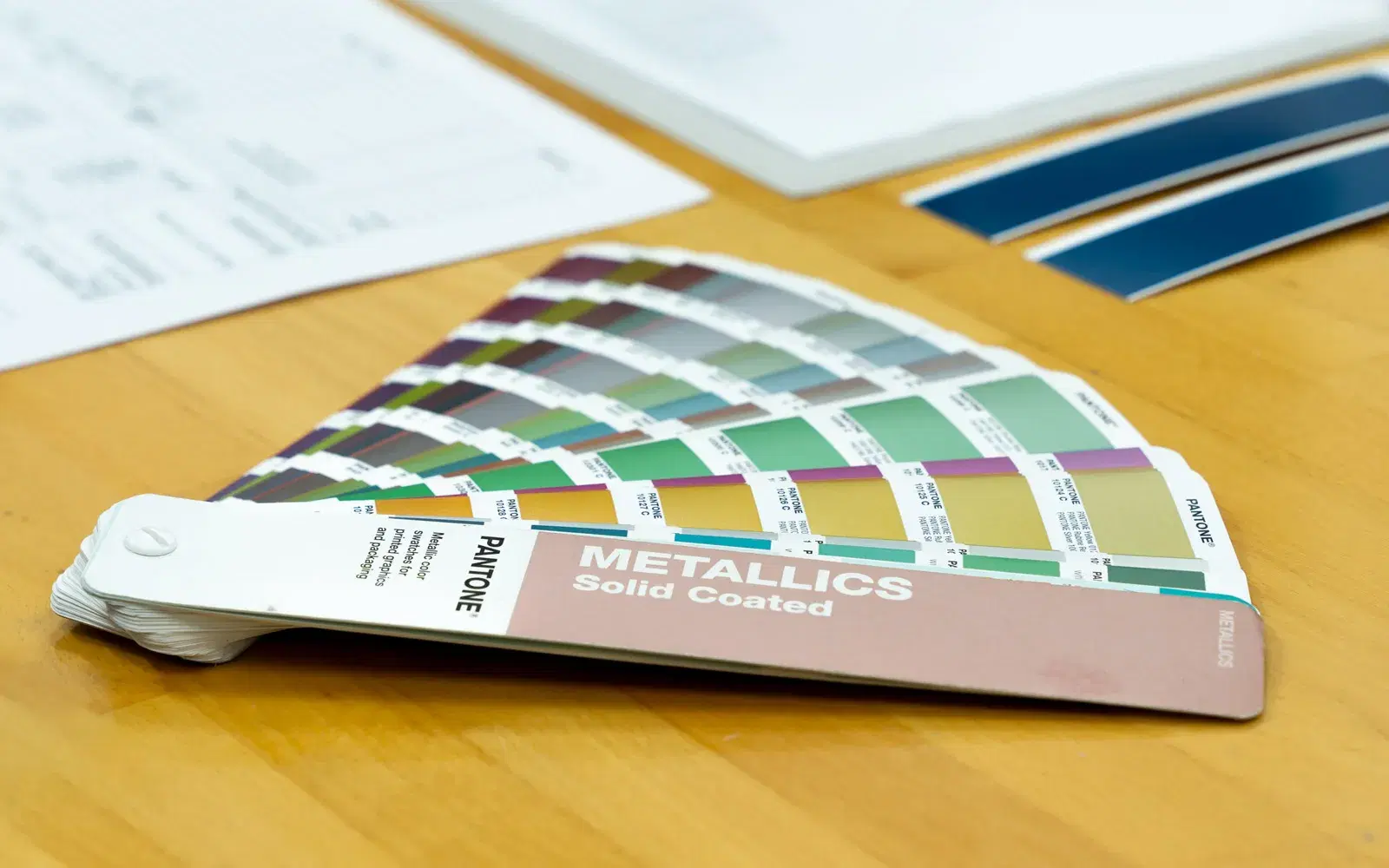
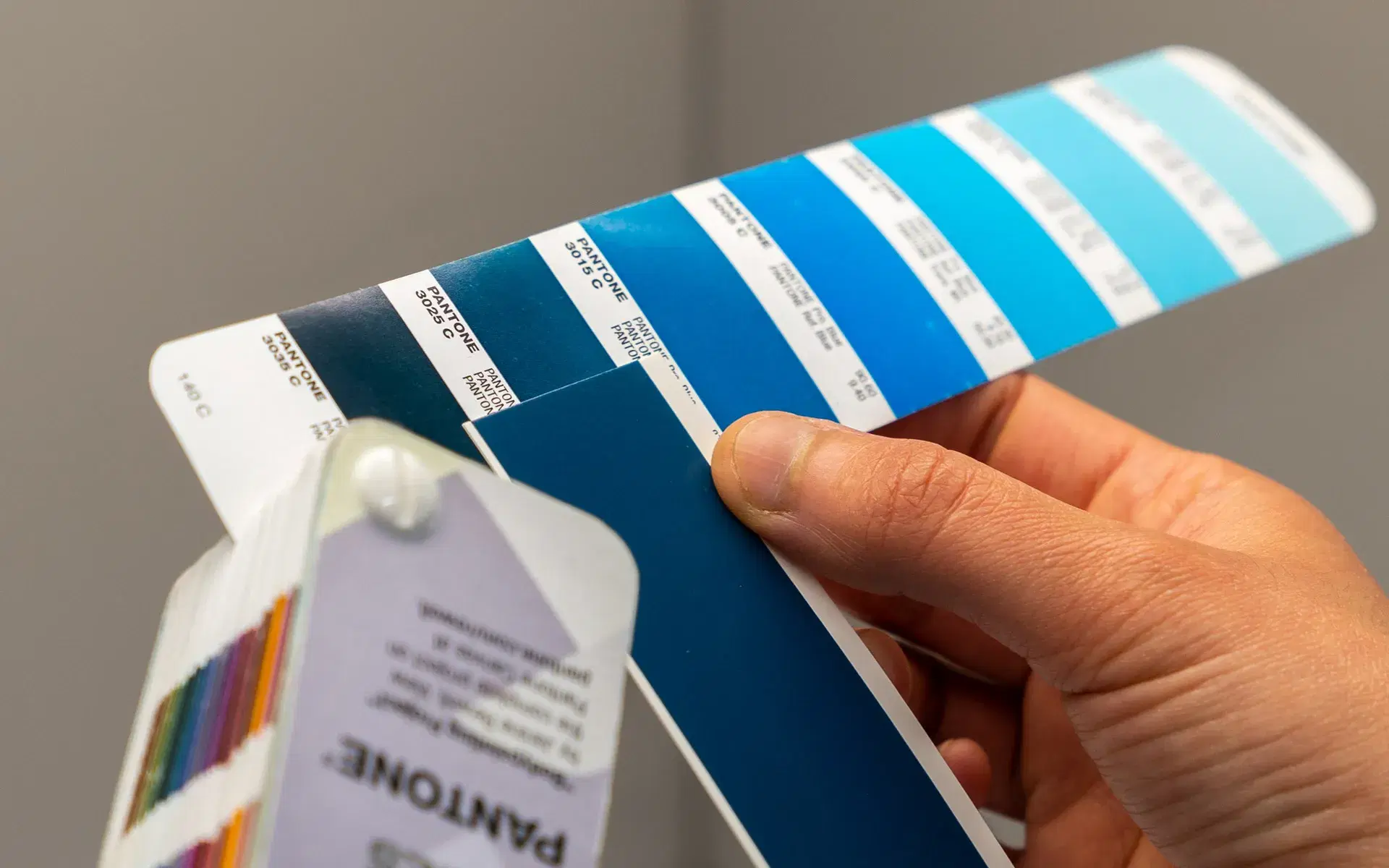
The second difficulty is the reference itself: a faded PANTONE guide, a guide from another year, an RGB simulation on screen or a sample from a different printing system may not be the true target. The first step of matching is therefore to verify the reference and make it measurable.
02CIE L*a*b* and Delta E: turning colour into numbers
The CIE L*a*b* colour space defines every colour the human eye perceives with three numbers: L* lightness (0 black, 100 white), a* the red–green axis, b* the yellow–blue axis. The difference between two colours is expressed as Delta E (ΔE); the industry uses the CIE 2000 formula (ΔE00). The smaller the value, the closer the colours; the table summarises what each range means.
| Delta E (ΔE00) | Perception | Use |
|---|---|---|
| < 1.0 | Not noticed even by a trained eye | Critical brand colours, lot repeats |
| 1.0 – 1.5 | Noticeable on careful side-by-side comparison | SIM custom colour target (< 1.5) |
| 1.5 – 3.0 | Noticed by a careful eye | ISO 12647-2 process colour tolerance (≤ 3.0) |
| > 3.0 | Clearly different | Not acceptable; reformulate |
03The SIM colour matching process: six steps
| Step | What is done | Output |
|---|---|---|
| 1. Reference intake | PANTONE code (with paper type), printed sample, physical object or L*a*b* value; target paper and printing system (conventional/UV) defined | Verified target |
| 2. Measurement | L*a*b* and spectral curve measured with a spectrophotometer under D50 | Numerical target |
| 3. Formulation | Computer-aided recipe calculation; starting mix from base colours | Initial recipe |
| 4. Press trial | Proof on the target paper; Delta E measured; iterative correction if needed | Sample approved at ΔE < 1.5 |
| 5. Customer approval | Sample and measurement report shared; approval taken in writing | Approved reference |
| 6. Production and archive | Batch production, batch number, recipe and spectral data archived | Delivery + repeat-order guarantee |
Target Delta E below 1.5; the approved sample's recipe and spectral data are archived. Repeat orders are produced with the same pigment source and the same recipe, and lot difference is checked by measurement.
04Types of reference: PANTONE code, sample, L*a*b*, a colour from nature
The fastest route is a full PANTONE code with paper type (e.g. 2935 C) and the guide year. A printed sample is the second-best reference: its surface, whether it is varnished and its age are noted. An L*a*b* value is a directly measurable target, provided the illuminant (D50/D65) and observer angle (2°/10°) are stated. A physical object (fabric, plastic part, leaf) or an on-screen RGB/HEX value can also serve as reference; in that case the target is first converted to the closest printable colour on the target paper and agreed with the customer as the "achievable target". For code systems see the Pantone colour codes section.
05Effect of paper, varnish and printing system: UV and conventional
The same recipe gives a different Delta E on coated and uncoated paper, so matching is done on the target paper and two surfaces may need two recipes. A varnish or lamination on top slightly darkens the colour and changes gloss; if varnish will be applied, the proof is varnished too. UV inks can shift colour after curing; the laboratory measures the cured sample and compensates. Metallic and fluorescent colours are formulated with special pigments rather than standard base colours, and gloss (GU) is measured separately.
06Spot colour or CMYK simulation?
Not every brand colour needs a custom ink. Colours that sit inside the CMYK gamut with a wide tolerance can be simulated with the four-colour screen; but vivid oranges, greens, purples, pastels and metallics stay at Delta E 2–5 in CMYK and risk printing differently on every run. A spot ink makes sense for logo colours, packaging background colours and recurring brand elements; CMYK simulation for one-off, multi-colour jobs without tight tolerance. Tie the decision to a measurement: simulate the target L*a*b* in the CMYK profile (FOGRA39/51) and choose a spot colour if Delta E exceeds 2. The full comparison is in our CMYK vs spot colour article.
07Common mistakes in custom colour matching
The first mistake is giving the reference as a screenshot: RGB is a simulation, not a target. The second is not stating the paper type; the same recipe looks different on coated and uncoated stock, and if approval is taken on the wrong paper the production run is rejected. The third is approving against an old or faded PANTONE guide; guides should be renewed every one to two years. The fourth is not mentioning varnish or lamination; varnish darkens the colour and the difference appears later if the proof was unvarnished. The fifth is not keeping the approved sample, leaving no physical reference for the repeat order. The sixth is not holding density constant on press: a colour matched in the laboratory shifts when film thickness changes. All of these are prevented by the reference checklist and the measurement report, which international customers receive in English.
08Recipe consistency: the same colour on repeat orders
The enemy of colour consistency is not the recipe but the variables: a base colour whose pigment source changed, a different paper lot, a different film thickness or an ageing reference. SIM's laboratory archives the recipe, base-colour lot numbers and spectral data of every approved colour; repeat orders are produced with pigment of the same origin and the sample is measured against the archived value before dispatch. On the press side, keeping target density and film thickness constant removes the largest source of proof-to-print difference. For export customers the archived data means the same colour can be re-ordered years later without a new sample.
09Lead time, minimum order and the 24/7 laboratory
The laboratory runs 24/7 and prioritises urgent jobs. The minimum order for a custom colour is 5 kg; stock PANTONE series have no minimum. Lead time is 1–3 working days after sample approval; within Istanbul, stock items ordered by 12:00 are delivered the same day and across Turkey within 1–2 working days, while export orders ship by road, sea or air. A monthly custom colour capacity of 15,000 kg allows single-lot production even for long packaging runs. International customers receive English TDS/SDS and the measurement report with the quotation.
10Checklist: sending the right reference
| What to send | Why |
|---|---|
| Full PANTONE code + paper letter (C/U) + guide year | The same number looks different on C and U; an old guide may have faded |
| A sample of the target paper (grammage, coating) | The recipe is verified on the target paper |
| Printing system: conventional, UV, LED-UV | Curing shift and vehicle system change |
| Varnish/lamination details | Varnish changes colour and gloss; the proof is varnished |
| Printed sample or L*a*b* with illuminant, if available | A measurable target; a screenshot is not a reference |
Send us your colour reference; our laboratory will measure it, formulate it and prepare the sample with a measurement report. Process and capacity details are on the custom colour production page; after approval, production is delivered within 1–3 working days.
Gallery
Frequently Asked Questions
- How does the custom color matching process work?
- A reference color is received (Pantone code, physical sample, or L*a*b* values), measured with a spectrophotometer, and a target formula calculated in the L-A-B digital color formulation system. A sample is produced, measured, and upon approval, moved to full production. SIM delivers in an average of 4-8 hours.
- What is the L-A-B color formulation system?
- L-A-B is a digital color matching software based on the CIE L*a*b* color space. The L*, a*, b* values of the target color measured by spectrophotometer are used to mathematically calculate the optimal ink mixture formula. It enables objective, repeatable color production independent of human eye variation.
- What is the minimum order quantity for custom color matching?
- The minimum custom color production quantity at SIM is 5 kg. With a monthly production capacity of 15,000 kg, both small and large volume orders can be fulfilled. There is no minimum quantity restriction for standard stock colors.
- Can you convert an on-screen (RGB/HEX) colour into ink?
- Yes, but a screen colour is a starting point, not a reference: the RGB/HEX value is converted to L*a*b* and then to the closest printable colour on the target paper; for out-of-gamut shades (very vivid orange, green, purple) the achievable target is agreed with the customer. Approval is always taken on a printed sample.
Related Products
SIM Baskı Malzemeleri
Get a Custom Quote for Your Project
Contact us for information about our wide product range and custom color production.